Comments()
  Print
Print  Mail
Mail  Large Medium Small
分享按鈕
0
Large Medium Small
分享按鈕
0|
|
|
The expensive ginseng is sold in bundles at a Fusong market. Raymond Zhou / China Daily |
My biggest discovery in Fusong, Jilin province, was that its ginseng looks nothing like the kind of ginseng I previously knew. It's so leafy that it can look like a carrot.
Besides, ginseng is not always sold in neat boxes with one side showing the dried roots. The man I met outside the Fusong farmers' market was selling it in the way cabbages are sold in the rest of the country - using the weight scale common to food stalls.
A walk through the market at an annual ginseng festival is an education in itself on the varieties and states of the herb, which is sometimes hailed as the "king of all herbs".
Then again, Fusong has the nickname "the hometown of ginseng in China".
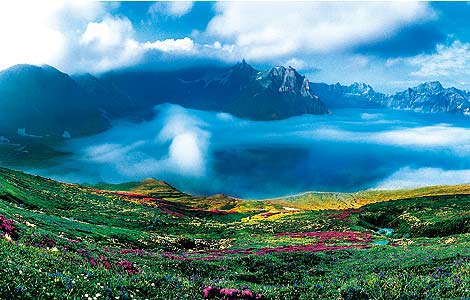
Located at the foothill of Changbai Mountain, Fusong is home to Asian ginseng, which grows in dense forests with little sunshine. Hence, its so-called warm properties, as yin begets yang in traditional Chinese culture.
I guess part of the reason is that ginseng can be an aphrodisiac. Ginsenosides, the active compounds of the Asian variety, have been proved to facilitate penile erection. But caution should be exercised, as an overdose can push the stimulating effect to nausea, nose bleeds, irregular blood pressure and breast pain.
Just remember that too much of a good thing can be a Well, you know what I mean.
In Chinese language, ginseng starts with the word "human". This is no coincidence. The plant is often seen as human - partly because the root has a slight resemblance to a human figure with legs and outreached arms, somewhat like the gingerbread man, and partly because it has been deified through ages of legends and mythologies.
One legend claims a ginseng fairy fled the celestial palace to bathe in Changbai's mountaintop lake. This act of disobedience was punished by the heavenly father, and she ends up marrying a mortal.
An epidemic washed over the human world, and she scattered ginseng seeds throughout the forest. Thus grew a magical plant that cured the infected population.
This angered the authoritarian father, who snatched her away and enslaved her in a cave. Her earthbound husband died pining for her.
It is an obvious variation of the more famous love story between the Seventh Fairy and the young farmer Dong Yong. Anyway, Fusong has a history of almost 1,300 years of harvesting ginseng. The practice of cultivating ginseng dates back 400 years.
As many as 15,000 people participate in ginseng planting and cultivate 5 million square meters. Ginseng accounts for some 60 percent of the county's agribusiness.
A more realistic yet fantastic tale is that of Sun Liang, a Shandong farmer who, in an attempt to escape starvation, sailed across the Bohai Bay and trekked into the Changbai Mountain in search for what locals called "the stick".
Instead of finding the plant and making a fortune, he died in hunger but left an inscription on a stone. He was later hailed as the predecessor of all ginseng farmers - or, rather, hunters.
Even some of the Qing Dynasty (1644-1911) emperors recognized his deed as heroic and commemorated him.
However, during much of the Qing, Changbai area was sealed off as sacred ground for Qing rulers' ancestors. Migrants from the Central Plains, especially such places as Shandong province, had to sneak in and make a living on the rich resources.
There is a lot of superstition about what you can say and cannot say while digging for ginseng. This might have been developed from necessity but evolved into a ritual.
When anyone in a group locates a ginseng plant, he must yell "stick" so the "stick" freezes and can't fly away.
The head of the group will ask "what variety", to which the finder would give out a code name.
Once a ginseng is correctly identified, only the leader can dig it up. He would either use a straw hat to cover it up first or use a string to tie it up - all for the purpose of preventing its escape.
Essentially, ginseng is treated like a runaway kid who seeks freedom from hunters.
Locals identify ginseng by the number of leaves and offshoots.
A 1-year-old ginseng has three leaves, while 2-year-olds have five leaves, which create the shape of a human palm. At 3 years old, it grows two offshoots, each with five leaves; 4 years beget three offshoots, and 5 years produce four. By the sixth year, it will have five offshoots.
Rarely does it grow six offshoots, and when it does, it becomes rare and extremely precious.
Diggers will mark the discovery by carving a symbol in the bark of a nearby tree, complete with information on the number of offshoots and leaves.
Latecomers will then know this place grows ginseng, and it has been harvested.

 Michelle Obama addresses at Democratic National Convention
 Slides of Yanbian: place, people and prosperity
Copyright 1995 - 2010 . All rights reserved. The content (including but not limited to text, photo, multimedia information, etc) published in this site belongs to China Daily Information Co (CDIC). Without written authorization from CDIC, such content shall not be republished or used in any form. Note: Browsers with 1024*768 or higher resolution are suggested for this site.
License for publishing multimedia online 0108263 Registration Number: 20100000002731