
 Comments()
  Print
Print  Mail
Mail  Large Medium Small
 |
|
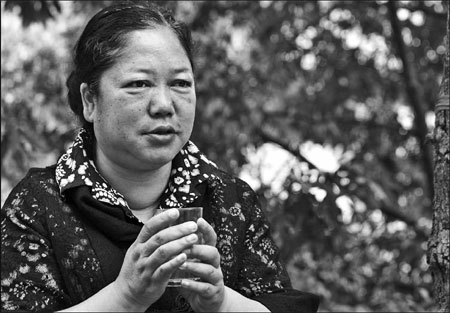
Zhang Hongzhen: Her transition from academic to fieldworker is driven by her strong convictions that the Hani way of life must be preserved. Li Jincan / for China Daily |
Related: Hani harmony
She lives and dreams about them and when she talks, her eyes light up with the inner fire of her convictions. Pauline D. Loh speaks to Zhang Hongzhen, the chief crusader for the preservation of the Honghe Hani terraced fields.
In my eyes, Zhang Hongzhen is beautiful. She is 48, born in the Year of the Dragon, and her consuming passion glows like a fiery aura about her. While she has the vision to see beyond the present and anticipate the problems of preservation of the Honghe Hani Rice Terraces, she also has an intimate eye and attention for detail. She wants to show us all that is good about the Hani agriculture heritage, and she goes to great lengths to showcase it all at its best. So, she makes sure we taste the finest local tea as we gather in her room for a chat about her favorite subject.
It is called Cloud Mist Tea and it is grown on the hillsides that capture the moisture as it rises from the valleys, a clean, fresh green tea that reflects the clean, fresh air in which it grows.
In the morning, she brings us to the best restaurant serving red rice vermicelli for breakfast, and we dine on a wooden deck that looks out over the valley. Breakfast with a view.
Zhang also makes sure we get a tour of the local farmers' market where she proudly shows off the diversity of the local produce, all natural, all organic and all grown within 50 kilometers of Yuanyang old town.
All day the day before, and all day that day, she tirelessly leads us around the winding mountain route, stopping whenever she feels we should see something interesting.
That something may include a hidden stream, a sacred grove of trees, a thanksgiving shrine, a section of hillside where the rich loam layer and underlying clay strata can be clearly seen.
We obediently trot out of our cars and squat by roadside wetlands that act as natural filters for water, and peer into ponds in search of loaches, dragonfly larvae and tadpoles that are so much a part of the ecosystem.
We go in search of tree lichen that is eaten cold or hot by Hani villagers. It looks like sphagnum moss but tastes like crunchy seaweed.
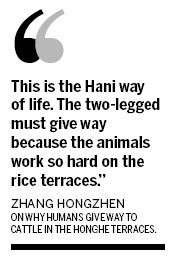
As we walk along the narrow lanes carved out of the hills, she pulls me aside to let a couple of buffalo and their herders pass.
"This is the Hani way," she tells me. "The two-legged must give way because the animals work so hard in the terraces."
So we quietly fall behind cows as they saunter along the path, and wait patiently as they stop for occasional bites of the wild herbs that grow at mouth-level.
Even along the roads, cattle get right of way. Any impatient driver who dares to hurry the animals with a blast of the horn gets glared at - by the buffalo, by the farmers, by Zhang and by day two, the China Daily team.
Make no mistake. For all that Zhang is devoted to the preservation of her Hani heritage, she is not a farmer. In fact, what she studied had nothing to do with agriculture. She was a qualified lecturer training government officials, most of whom came from the rural offices.
Interaction with her students got her interested in what she is doing now, and she made a momentous career switch.
As head of the agriculture management body for the Honghe Hani Rice Terraces, Zhang is using every trick in the book to promote them.
She tweets about them everyday on China's most popular blogging site, and spearheaded the start of an extremely informative website on the rice terraces, their cultural heritage and history.
She is also editor of a comprehensive set of books about the Hani way of life.
I first met Zhang in Kunming, where we were supposed to do a food tasting at a wellness restaurant. As the evening progressed, and the chefs and owner warmed up to us, Zhang persuaded them to try the Hani red rice.
When the owner expressed support, she immediately called back and placed the order.
It is with this same passion that she introduces us to a restaurant serving Hani cuisine in Mengzi city in Honghe, where she is based most of the time. As we slowly work our way through the menu, she patiently explains each item of produce and their role in the micro-ecology of the rice terraces.
It was a sumptuous taste of what is to come.
As journalists, we meet countless officials all too eager to show us their best offerings. In Zhang we encountered a rare, even endangered species.
She was honest with us, acknowledging the advantages and disadvantages, recognizing the strengths and weaknesses of the system.
And she was willing to admit that she and her team are on an extremely steep learning curve.
One thing we do know: With people like Zhang Hongzhen at the helm, the Honghe Hani Rice Terraces is in safe hands.
Contact the writer at paulined@chinadaily.com.cn.



Copyright 1995 - 2010 . All rights reserved. The content (including but not limited to text, photo, multimedia information, etc) published in this site belongs to China Daily Information Co (CDIC). Without written authorization from CDIC, such content shall not be republished or used in any form. Note: Browsers with 1024*768 or higher resolution are suggested for this site.
License for publishing multimedia online 0108263 Registration Number: 20100000002731