Comments()
  Print
Print  Mail
Mail  Large Medium Small
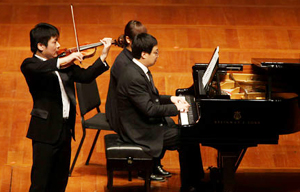
Common Zhuang musical instruments include suona (Chinese cornet), bronze drum, cymbal, gong, sheng (Chinese wind pipe), xiao (vertical bamboo flute), di (Chinese flute) and huqin (a stringed instrument) made of horse bones.
Zhuang dances are characterized by distinct themes, forceful and nimble steps, jocular and humorous gestures and true-to-life emotions. The Rice-Husking Dance, Silk-Ball Dance, Shrimp-Catching Dance, Tea-Picking Dance, Shoulder-Pole Dance and Bronze-Drum Dance not only vividly depict the Zhuangs' life and work, but also display their straightforward, unbending nature.
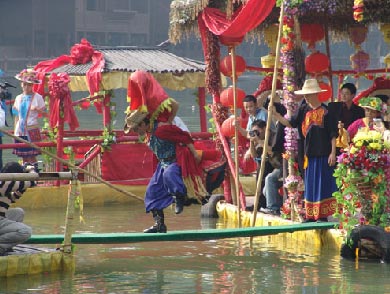
Yet what combines the Zhuangs' folk literature, music, dance and other forms of art is the Zhuang Opera, which first originated from religious rites in the Tang Dynasty.
Customs and Habits
Most Zhuangs now live in one-story houses the same as the Hans. But some have kept their traditional two-story structures with the upper story serving as the living quarters and the lower as stables and storerooms. The old housing style, they think, suits the mountainous terrain and the humid climate.
Contemporary Zhuang clothing is in general close to the wear of the Han people. But traditional dresses remain in many places or are worn for special occasions. In northwest Guangxi, for instance, elderly women like collarless, embroidered and trimmed jackets buttoned to the left together with baggy trousers, embroidered belts and shoes and pleated skirts. They fancy silver ornaments. Women of southwest Guangxi prefer collarless, left-buttoned jackets, square kerchieves and loose trousers -- all in black.
Tattoo used to be an ancient Zhuang custom. A great writer of Tang Dynasty, Liu Zongyuan, mentioned it in his writings. Chewing betel nuts is a habit still popular among some Zhuang women. In places such as southwest Guangxi, betel nuts are a treat to guests.
Rice and corn make up the Zhuangs' staple food, and glutinous rice is particularly favored by those in south Guangxi.
The Zhuangs are monogamous. But they have a strange custom -- the wife stays away from the husband's home after marriage. At the wedding, the bride is taken to the bridegroom's home by a dozen girls of the same generation. She returns to live with her parents the next day and visits her husband only occasionally during holidays or the busy farming seasons. The woman will move permanently to the man's home two or three years later. This convention, which often impairs the harmony between husband and wife, has been going out of existence.
While sharing many festivals with the Hans, the Zhuangs have three red-letter days of their own: the Devil Festival, the Cattle Soul Festival and the Feasting Festival. The Devil Festival, which falls on July 14 on the lunar calendar (usually in August on the Gregorian calendar), is an important occasion next only to the Spring Festival. On that day, every family would prepare chicken, duck and five-colored glutinous rice to be offered as sacrifices to ancestors and ghosts.
The Cattle Soul Festival usually follows the spring ploughing, when every family would carry a basketful of steamed five-colored glutinous rice and a bundle of fresh grass to the cattle pen. After a brief sacrificial rite, they would feed the cattle with the grass and half of the rice. They believe that the cattle have lost their souls because of the whipping during the spring ploughing and that the ritual would call back the lost souls.
The Feasting Festival is celebrated only by people who live near the Sino-Vietnamese border. Legend has it that a group of Zhuang soldiers, having repulsed the French invaders in the late 19th century, returned in late January and missed the Spring Festival. To pay tribute to them and celebrate the victory, their neighbors prepared a sumptuous feast for them.



Copyright 1995 - 2010 . All rights reserved. The content (including but not limited to text, photo, multimedia information, etc) published in this site belongs to China Daily Information Co (CDIC). Without written authorization from CDIC, such content shall not be republished or used in any form. Note: Browsers with 1024*768 or higher resolution are suggested for this site.
License for publishing multimedia online 0108263 Registration Number: 20100000002731