Comments()
  Print
Print  Mail
Mail  Large Medium Small
The excavations carried out at Yinxu and the finding of the oracle bones significantly changed China's historical records. The inscriptions on these bones are the precursor of modern Chinese calligraphy, according to Tang Jigen, a researcher with the Institute of Archeology, Chinese Academy of Social Sciences.
But why would the ancient people write on bones, which, experts said, was not an easy task?
On close inspection, pinholes and burn marks are visible on the unwritten side.
This proves that writing on bones had to do with witchcraft, which people in the distant past used to communicate with the gods, archeologists say.
Will there be rain tomorrow? Will we win the upcoming war? Will the queen give birth to a male heir? Was the lunar eclipse an ominous sign?
"People who lived thousands of years ago would put these questions to their gods or ancestors," says Tang, the team leader of the archeological excavation at Yinxu.
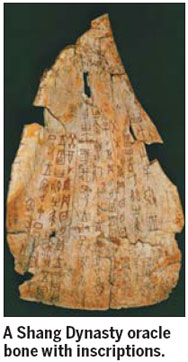
Holes were drilled into tortoise shells or ox bones so that cracks would appear on the other side when charcoal pieces were burnt inside them during sacred rituals. As the bones cracked with burning, mysterious explosive noises were taken to be messages from gods or ancestors.
Wizards would interpret a crack's features and on its basis predict the future, which would be carved on the bones, using knives. That's the oracle bone inscriptions, as we know them.
"Bone writing is not simply theomancy of the kings in Shang Dynasty (16th century-11th century BC), but contains a general overview of the kingdom itself, including important information about the ancient time," Tang explains.
The writing in Yinxu's bone-scripts covers quite a range - from politics to social traditions. More than 100 variety of handicraft was mentioned, besides a wide array of information on astronomy, calendar and medication.
What's more, archaeologists' study of the oracle bones has helped confirm the existence of the Shang Dynasty, which would often be doubted.
The discovery of the oracle bones late in Qing Dynasty (1644-1911), however, was largely a coincidence. Local farmers who first spotted them while working in the fields sold these to pharmacies at very low prices. They were called "dragon bones" and were supposed to have medicinal value.
It is said Wang Yirong, a late Qing Dynasty official and an expert in bronze and stone inscriptions, happened to notice the writing when he bought the bones for their supposed medicinal value in 1899.
Wang, who concluded the bones were valuable antiques, was the first to study them and collect them in great numbers.
At that time antiquarians had reservations about the source of the bones. It wasn't until 1908 that Xiaotun village in Anyang was identified as the place where the oracle bones were unearthed.
Dealers, tomb raiders, and excited scholars rushed to get hold of a piece immediately afterwards.
During an excavation in 1936, an intact storage pit, where 17,096 bone pieces lay, were unearthed. It was the largest number of oracle bones unearthed during a single excavation and the treasure, mostly tortoise plastrons, took several workers eight months to clean and label.
A total of 150,000 pieces of bones have already been excavated in Yinxu, and about 4,500 different characters identified in Yinxu's bone scripts. These are the earliest systematical Chinese writing ever known.
"Over the past century, scholars have only interpreted about 1,500 characters," Tang says. "A large portion of the characters remains incomprehensible."
The bone writing has a strong pictographic nature, and many strokes and elements do not form fixed patterns. However, it has fixed grammar structures.
Though the writing styles of Chinese characters have evolved over tens of centuries, many basic and grammatical features of oracle scripts have survived, and are, in fact, still in use by more than a fifth of the world's population.
The oracle scripts not only laid a foundation for the origin and evolution of Chinese calligraphy, but have also had a strong impact on Chinese aesthetics, Tang adds.



Copyright 1995 - 2010 . All rights reserved. The content (including but not limited to text, photo, multimedia information, etc) published in this site belongs to China Daily Information Co (CDIC). Without written authorization from CDIC, such content shall not be republished or used in any form. Note: Browsers with 1024*768 or higher resolution are suggested for this site.
License for publishing multimedia online 0108263 Registration Number: 20100000002731