
 Comments()
  Print
Print  Mail
Mail  Large Medium Small
分享按鈕
0
Large Medium Small
分享按鈕
0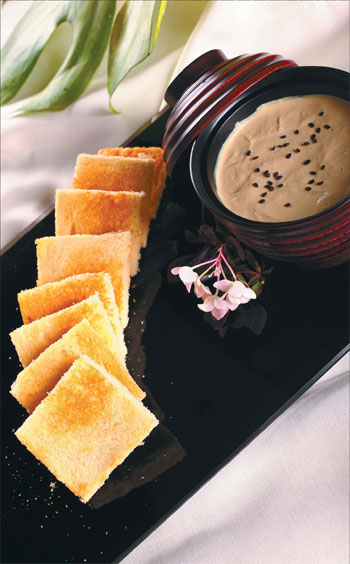
|
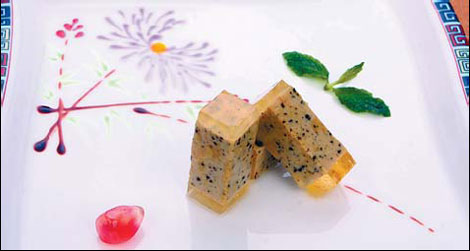
Some restautants have taken to serving foie gras marinated in the Japanese alcohol, sake, to subdue its oily texture. Photos provided to China Daily |
But you don't have to pay through the nose to tickle your taste buds with luxury fare.
If you think truffles, high-quality grain-fed marbled beef, foie gras and other luxurious and sinfully delicious ingredients mean bank-breaking visits to expensive restaurants, think again.
You'll find that although the love affair with foie gras is cooling off and a passion for caviar has yet to be ignited, truffles and top-quality beef are all the rage with local gourmet chefs.
Huang Jingkun, a chef at Colorful Yunnan, a restaurant in the northern part of the capital, said he's seen the demand for truffles triple since they were introduced on the menu in 2009 and he expects the consumption of the "king of foods" in his restaurant to hit an all-time monthly high of 120 kilograms this march.
To fuel Chinese taste buds the fires of desire for the Western delicacy, the restaurant offers truffles with cod, sea cucumber, and in a traditional Chinese soup. Because the precious fungi are sourced from the southern province of Yunnan, they cost a fraction of what they would in the West, but prices still range from 198-780 yuan ($31-124) per dish.
Da Dong, a restaurant on the eastern fringes of Beijing is better known for its Peking duck, nonetheless it offers truffles in a traditional abalone sauce, for a mere 980 yuan. Cheaper options are truffle served on an iron pan with rice, which costs 280 yuan, or there's the shockingly low 40-yuan per serving truffle-flavored chocolate for those with a sweeter tooth. Da Dong says that its truffles come from Italy and are big hit with customers, second only to its time-honored roast duck in popularity.
Meanwhile, at the South Beauty restaurant downtown, the chefs can provide high-quality grain-fed marbled beef cooked in the restaurant's trademark Sichuan style. It can also be done kungpao style or stir-fried.
One frequent visitor to South Beauty is Ye Junhuai, a Shanghai film director, who recently ordered a plate of beef, some steamed abalone, fish fillets in hot sauce, some chicken, and several servings of vegetables, for five people.
"My requirements are quite simple. It just has to be really tasty and healthy," said Ye.
Although there is still a large demand for truffles and top-quality beef, the once popular foie gras seems to have fallen out of favor.
Foie gras was the darling of Beijing's up-scale restaurants a few years ago, but the capital's diners now consume half the amount they did when its popularity was at its peak in 2008.
Jack Zheng, a sales manager at China's major foie gras producer, Zhengfang Food, said that goose liver has indeed fallen out of favor and, he has seen a big dip in sales this year compared with his high point in 2008, when it brought in more than 30 million yuan at Zhengfang's Beijing outlet.
These days, some restaurants have taken to serving foie gras marinated in the Japanese alcohol, sake, to subdue its oily texture, but even this attempt to bring back its lost glory by making it lighter and fresher appears to have failed.
"It's the cholesterol that's scared customers off," said Huang of Colorful Yunnan.
Zhou Ting, an assistant professor at the University of International Business and Economics who studies lifestyle trends, told China Daily, "Health is definitely one of the most important things on people's minds. Food is more important than clothing or handbags. People take everything in, so it's and indication of their standard of living."
And, people are also cost-conscious when it comes to having a try at "luxury" food items. A random check of restaurants in the city, for example, revealed that caviar has yet to find a niche mainly because of the cost.
Baijia Dayuan, a restaurant in the city's southwestern part, whose cuisine is classic royal-style, says that few customers ask for caviar. Their only dish with caviar has just a tiny pinch of the pearls scattered across some scallops. However, the owners say that if they get enough positive feedback, they would be willing to serve more caviar dishes.
Zhou, makes the modest suggestion that to really popularize non-traditional Chinese ingredients, chefs need to be more innovative and let diners' "experience food without limits".
"The market has barely been tapped," she added.
Sun Ye contributed to this story.
Copyright 1995 - 2010 . All rights reserved. The content (including but not limited to text, photo, multimedia information, etc) published in this site belongs to China Daily Information Co (CDIC). Without written authorization from CDIC, such content shall not be republished or used in any form. Note: Browsers with 1024*768 or higher resolution are suggested for this site.
License for publishing multimedia online 0108263 Registration Number: 20100000002731