A tick for flea studies
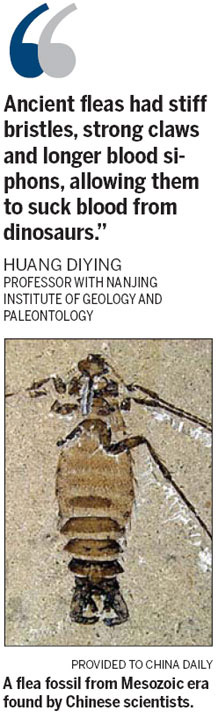
A flea as big as a dollar coin that may have sucked the blood of dinosaurs 160 million years ago has been discovered by Chinese scientists.
A paper, entitled Diverse Transitional Giant Fleas from the Mesozoic Era of China, published online by Nature, reveals the progress made by Huang Diying and his colleagues from Nanjing Institute of Geology and Paleontology of Chinese Academy of Sciences.
In recent years, Huang and his team have found nine fossils of giant fleas from the Middle Jurassic Daohugou biota at Ningcheng county, Inner Mongolia autonomous region, and the Early Cretaceous Jehol biota at Beipiao city, Liaoning province.
These findings trace back to the earliest occurrence of fleas in the Mesozoic era. The fossils provide new insights into the origin and early evolution of fleas and the adoption of hosts, Huang explains.
Huang says the non-jumping fleas grew up to 20 mm long, while modern fleas are typically 1 to 3 mm. The giant fleas have primitive traits that widely differ from their modern relatives.
"Ancient fleas had stiff bristles, strong claws and longer blood siphons, allowing them to suck blood from dinosaurs," Huang says.
The stout sucking siphons for piercing the hides of their hosts, suggests they may be related to the pollinating "long siphonate" scorpion flies, also of the Mesozoic era.
Their morphology suggests their earliest hosts were hairy or feathered "reptilians", and that they radiated to mammalian and bird hosts in the Cenozoic, from 65 million years ago.
"Ancient fleas did not have the powerful hind legs seen on modern fleas, although their flat bodies made it easy for them to latch on to a variety of animals," Huang explains. "In other words, the ancient fleas couldn't jump, but instead crawled on their hosts."
Fleas, including about 2,500 recent species or subspecies, are one of the most dramatically specialized group of insects.
However, definitive fossil evidence of fleas has been largely confined to Cenozoic amber, which is why evidence for the origin and early evolution of fleas is lacking.
Only one fossil flea, Tarwinia, has been described as being the Late Cretaceous in Australia.
The Mesozoic fleas vary from approximately 15 mm in length, to more than 20 mm. Like fleas today, the females are larger.