Finding a way forward to give
 |
|
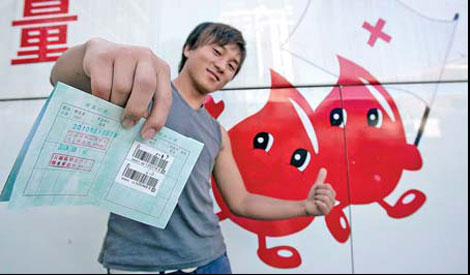
A college student shows off his blood donation certificate in Kunming. Yang Haidong / For China Daily |
Thirty years ago, a blood donation certificate was vital for those who wanted to join the Communist Party of China or sought promotion within State enterprises.
In the 1990s, civil servant Sui Guimin was given six consecutive awards for voluntarily donating blood.
But it was around this time that the country started experiencing a blood shortage due to a lack of donors, and incentives were introduced.
Sui, along with other State employees, was given bonuses, such as holidays, food and money.
"All donors were given a 15-day holiday, a two-day outing, eggs and milk and a subsidy of 500-700 yuan ($79-$111)," the 57-year-old says.
"Anyone who didn't donate would be fined 50 yuan."
This initiative made the public believe giving blood would deplete the body - hence, the offer of rest and extra food - and this reduced donations.
Therefore, some State organizations hired professional donors at labor markets who made huge profits.
Ministry of Health figures from 2004 indicate unpaid blood donations accounted for 71.5 percent of the total donations, despite the 1998 introduction of China's Law on Blood Donation that emphasizes voluntary donations.
The 2011 Ministry of Health statistics suggest 99 percent of the blood stored at clinics is voluntarily donated.
However, the demand for blood is growing, as there are more surgeries and cures that require large amounts of blood.
In 2010, the number of patients who underwent surgery increased 18.6 percent, while the amount of blood donated went up 7.7 percent.
"We need more than 6,000 tons of blood by 2015," deputy secretary of the Ministry of Health Guo Yanhong says.
"That means 120,000 people have to donate blood every day."
However, the donation rate per 100 people in China is just 0.87 percent, 4.5 percent lower than in high-income countries.
The World Health Organization holds that blood shortages are inevitable when the donation rate is lower than 1 percent.
Tongzhou Blood Bank, one of two Beijing Red Cross blood centers, normally collects 400 to 500 units (a unit is 200 cubic centimeters) of blood a day, but the volume has fallen to about 100 units since 2011. The average allocation to every hospital in eastern Beijing is fewer than 2 units.
Cao Xumei, director of the blood transfusion department at No 1 Affiliated Hospital of Tsinghua University, says he was alarmed by a serious blood shortage during the 2012 Spring Festival. Only 1,000 cubic centimeters were stored for every blood type inventory.
The hospital has been organizing voluntary blood donation activities to make up the shortfall. In November 2011, 58 medical personnel donated 12,800 cc.
Another initiative called "Mutual Help Blood Donations for Families" offers families an equal amount of blood to that which it donates, regardless of blood type.
Families are given blood donation cards, and the value can be exchanged for blood when it is required.