Comments()
  Print
Print  Mail
Mail  Large Medium Small
 |
|
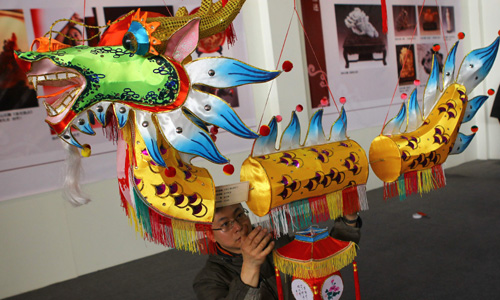
Yang Yurong, a national inheritor of intangible cultural heritage, shows his handmade dragon shaped lantern during a recent exhibition. Photo by Zou Hong / China Daily |
China is working to safeguard not only its own intangible cultural heritage but also that of the Asia-Pacific region.
This is seen in the International Training Center for Intangible Cultural Heritage in the Asia-Pacific Region (CRIHAP) under UNESCO, which was recently inaugurated in Beijing.
"CRIHAP wishes to help countries in the Asia-Pacific region better implement UNESCO's Convention for the Safeguarding of Intangible Cultural Heritage," CRIHAP Director-General Yang Zhi says.
"And we hope that through our capacity-building and training programs, more individuals, institutes and communities will participate in the safeguarding of intangible cultural heritage."
UNESCO adopted the Convention for the Safeguarding of Intangible Cultural Heritage in 2003 in consideration of the importance of intangible cultural heritage as a mainspring of cultural diversity.
As of December 2011, 142 of the 192 UNESCO members have ratified or approved the convention. In the Asia-Pacific region, 29 of 48 UNESCO members have become state parties to the convention.
CRIHAP is one of three centers for safeguarding intangible cultural heritage in the Asia-Pacific region under UNESCO.
The others are the center focusing on information and networking in the Republic of Korea and the center devoted to research on safeguarding in Japan. There is also a center in Iran, which combines all of these functions but with a geographic focus on Western and Central Asia.
UNESCO has approved the creation of two other intangible heritage centers in Bulgaria and Peru.
"Since 2010, UNESCO has put a strategic emphasis on strengthening the capacities of states parties to implement the convention," UNESCO's assistant director-general for culture Francesco Bandarin says.
"We are working hand in hand with governments, civil society and communities to ensure that safeguarding efforts are supported and sustained."
CRIHAP consists of a governing board, advisory committee and secretariat. The Chinese Ministry of Culture appoints the governing board's chairman. Vice-Minister of Culture Wang Wenzhang currently occupies the position.
CRIHAP's 2012 plan includes the organization of two international training workshops in China, and another two in Southeast Asia and the Pacific sub-region.
CRIHAP aims to train specialists familiar with the practical situations of different countries and areas in the Asia-Pacific region.
The center cooperates with many colleges and institutes in China, including the Chinese Academy of Social Sciences, Peking University and the Chinese National Academy of Art. It will later partner with foreign institutes in the Asia-Pacific region.
Yang says the short- and long-term training will be combined with fieldwork. It will also train journalists to enhance the media's role in intangible cultural heritage protection.
"We have been working on intangible cultural heritage on our own for many years, and we increasingly feel the need for further study," says Ma Yingsheng, deputy director of the Xinjiang Uygur autonomous region's culture department.
"Located on China's border, Xinjiang lacks information and, more importantly, an international vision."
Ma, who was an observer at CRIHAP's inaugural session, says Xinjiang's government personnel and community workers are most in need of training. Their concepts and methods must be updated to follow international development, Ma says.
Xinjiang hosts three items included on UNESCO's Representative List of the Intangible Cultural Heritage of Humanity.
China has 29 items on the list and seven items on the List of Intangible Cultural Heritage in Need of Urgent Safeguarding.
The country has also built its own intangible cultural heritage inventories. The State Council has listed 1,219 items as national intangible cultural heritage and 1,488 people as national inheritors of intangible cultural heritage.
"Safeguarding intangible cultural heritage is a new interdisciplinary area," International Institute for the Inclusive Museum executive director Amareswar Galla says.
"It deals with living things and introduces a new concept that still needs to be debated and understood. I think CRIHAP is very timely, because the Asia-Pacific region is a huge area where there is a shortage of experts on intangible cultural heritage. CRIHAP will have an extremely important role to play."



Copyright 1995 - 2010 . All rights reserved. The content (including but not limited to text, photo, multimedia information, etc) published in this site belongs to China Daily Information Co (CDIC). Without written authorization from CDIC, such content shall not be republished or used in any form. Note: Browsers with 1024*768 or higher resolution are suggested for this site.
License for publishing multimedia online 0108263 Registration Number: 20100000002731