Comments()
  Print
Print  Mail
Mail  Large Medium Small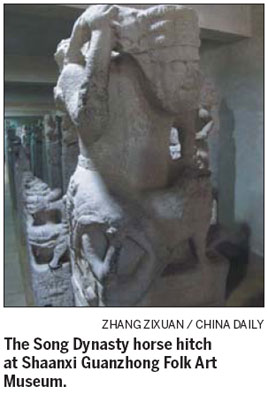
 |
Editor's Note: Every week we look at a work of art or a cultural relic that puts the spotlight on China's heritage.
Shaanxi's provincial capital Xi'an has been the capital of 13 dynasties and fascinates today's tourists with Qin Shihuang's underground legion of Terracotta Warriors and horses. But few know of the "aboveground terracotta army".
This is an army of horse-hitching posts, which are 2-meter-high cubic stone stakes crowned with sculptures. The oldest specimens can be traced to the Tang Dynasty (AD 618-907).
"Horses were essential to war and transport in olden times," Shaanxi Guanzhong Folk Art Museum's curator Wang Yongchao says.
Central Shaanxi's Guanzhong area was the largest horse-breeding ranch of several dynasties. That's why so many hitching posts were discovered in Guanzhong but few have been found outside it.
The posts were symmetrically staked outside houses' front gates to indicate a family's wealth and status. They were also believed to repel evil spirits. Sometimes, they appeared in groups alongside steppingstones.
The Xi'an Academy of Fine Arts has a collection of more than 2,000 horse-hitching posts.
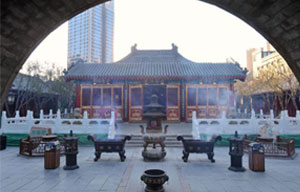
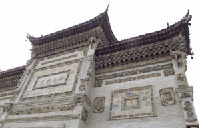
But even more are kept at the Shaanxi Guanzhong Folk Art Museum, China's biggest privately owned folk art museum.
More than 8,600 posts are exhibited in three parts of the museum.
The first section features the 2,000 most precious pieces, which are displayed in a special exhibition hall.
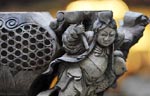
This hall's oldest horse-hitch was created in the Song Dynasty (960-1279). It features a lion tamer with a thick beard, carrying a machete, a sword and a pot. A lion lies beside his boots.
The image is of a man from one of ancient China's northern tribes. Similar images can be seen on many other stone posts, demonstrating the integration of nations during the period.
The second display hall features a smaller group of posts engraved with lions. These can also be seen throughout the museum's open yards.
The main avenue that connects the front gate and the exhibition courtyards, for example, is guarded by two rows of posts crowned with lion figurines.
The third part contains the rest of the posts, which comprise the museum's largest collection. They form the shape of the Eight Diagrams of Taoist cosmology and appear to be engaged in battle - hence, the colloquial name, "the terracotta army on the ground".
"These horse-hitching posts aren't simply ornamental columns," Central Academy of Fine Arts professor Jin Zhilin says. "They are representatives of Xi'an's folk culture."



Copyright 1995 - 2010 . All rights reserved. The content (including but not limited to text, photo, multimedia information, etc) published in this site belongs to China Daily Information Co (CDIC). Without written authorization from CDIC, such content shall not be republished or used in any form. Note: Browsers with 1024*768 or higher resolution are suggested for this site.
License for publishing multimedia online 0108263 Registration Number: 20100000002731