On a more positive note for tradition
Updated: 2012-02-13 11:21
By Wang Xiaodong and Huang Feifei (China Daily)
|
|||||||||


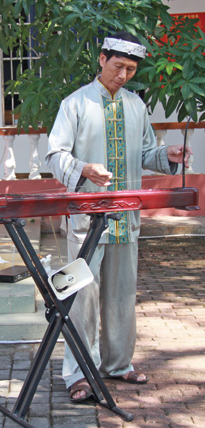 |
| Jing ethnic group duxianqin (one-string dulcimer) player Su Chunfa. Provided to China Daily |
More than 15 years after the event, duxianqin (one-string dulcimer) player Su Chunfa still fondly recalls his first performance in a music hall, at the Shanghai Tourism Festival in 1996, and the rousing applause at the end.
"The audience was excited and many waited in line to try it out for themselves afterwards," the 56-year-old says.
The duxianqin is fashioned out of a single bamboo reed and is played by the Jing ethnic group, which mainly live on the islands of Dongxing city, Guangxi Zhuang autonomous region. It was included on the national intangible cultural heritage list in 2011.
Having played the duxianqin for half a century and passed on his skills to hundreds of people, Su was designated as a successor of intangible cultural heritages in Guangxi, in 2008.
Su's connection with the duxianqin started when he was 5.
"When I was herding cows with my uncle, he often played the duxianqin when he had time to rest. Its shape was so interesting and the sound so beautiful I asked my uncle to teach me to play. However, he refused, saying I was too young then," says Su, from Wanwei village.
At the age of 11, Su and another four villagers started to learn the instrument, but it was so difficult Su's four classmates gave up after a few days.
"I feel so blessed that I did not give up," he says. "Now, there are few Jing people and even less play the duxianqin. That is why it is so important that this skill is passed on to a new generation."
He says he has taught more than 300 people to play the duxianqin.
"They come from every part of the country and I do not charge as it is my responsibility to help this art survive," Su says.
When he was young, like many other Jing, Su traded goods with neighboring Vietnam, then set up his own business to repair bamboo rafts and trade seafood.
"That is why I can afford the expense of training people to play the duxianqin for free," he says, adding his wife and kids now take care of his business.
"I like duxianqin very much," says Wu Hongyu, one of Su's students. "Although Su is very busy, he always instructs me whenever I visit him."
Su also takes pride in a troupe he has formed to entertain his fellow villagers.
"The 10-member team always performs during the Spring Festival," Su says. "Our performance is closely related to our culture and lives such as fishing and harvesting."