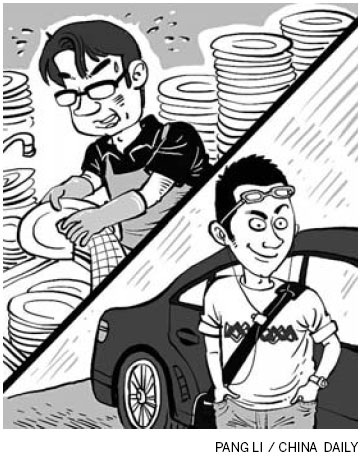
University students from China studying in the United States don't look like they used to.
When I was growing up in the 1980s, my southern US city was home to quite a few such students seeking advanced degrees in science and engineering. Many were customers of the small business my parents ran.
They wore ill-fitting clothes, including lots of short-sleeve plaid button-ups, and tooled around in old Honda and Toyota sedans, four or five people to a car.
They were here on scholarships and tuition waivers, and had little to spend on fashion or status symbols. If they had earnings from part-time jobs, I imagine that they saved or sent them to their families back home.
Upon graduation, these students found work and stayed in the US if at all possible. Now middle-aged, they hold senior positions in universities and corporations, live in big suburban houses and send their kids to Harvard, Cornell and MIT.
Of the 1.62 million Chinese students who went abroad to study between 1978 and 2009, only 30 percent have returned to their homeland, according to a study released in 2011 by Huaqiao University.
In the midwestern US city of Cincinnati, where I live now, I meet international students from the same mold. They're tackling master's degrees and PhDs in tough subjects, and academics come before style.
But they're more polished than their predecessors.
They wear Nikes and carry nice phones.
It may be that their parents are members of China's emerging middle class and can help them out a bit financially. Having grown up without the hardships that earlier generations faced, they are likely - when they have a few dollars - to head for a shopping mall.
Ask these students where they plan to live when they're done with school and they say they don't know.
They'll look for a job in the US but, given China's development, going home is a more attractive option than before.
Indeed, about 135,000 Chinese students returned home after graduation in 2010, up nearly 25 percent from 2009, Xinhua reported last year.
Meanwhile, a trend more striking than the changes in the Chinese graduate student population has been under way. American campuses have welcomed a new group: Chinese undergraduates.
About 57,000 undergraduates from China were enrolled in US colleges and universities in the 2010-11 school year, up 43 percent from the previous year, according to the Institute of International Education, based in Washington, DC.
Enrollment has been climbing over the last seven years as US schools learn to market to affluent Chinese families seeking an international education for their children. The parents tend to pay full price for tuition and housing, with costs totaling $40,000 a year or more.
These students drive Mercedes and BMWs. Everything they wear is a designer brand. I saw a guy the other day with a Louis Vuitton belt.
They major in business. Their parents are often involved in property development or mining, and I suspect these students have roles waiting for them back home when they graduate.
Both the graduate students and undergraduates whom I encounter seem dedicated to academics.
They are, like the Chinese students I observed as a youth, serious about an international education as a means of improving their lives, whether they settle in the US, China, or elsewhere.
But the stereotype of Chinese students as good at math but disconnected from American culture is outdated.
China's economic and social changes mean that the students it sends might well be the "cool kids" in their classes.

|
|
|
|
|
|
|
|

Copyright 1995 - . All rights reserved. The content (including but not limited to text, photo, multimedia information, etc) published in this site belongs to China Daily Information Co (CDIC). Without written authorization from CDIC, such content shall not be republished or used in any form. Note: Browsers with 1024*768 or higher resolution are suggested for this site.
License for publishing multimedia online 0108263 Registration Number: 130349 



























 Raymond Zhou:
 Pauline D Loh:
 Hot Pot
 Eco China
 China Dream
 China Face