What goes in must come out
Updated: 2012-01-28 15:18
By Wang Kaihao (China Daily)
|
|||||||||


It is New Year's Eve and a buffet restaurant in Beijing's China World Hotel is bustling.
Li Mengzhong, the hotel's assistant chief engineer, is busily inspecting the kitchen. One of his major duties is garbage disposal.
"It's very complicated work," Li says. "We have to put the mess in order."
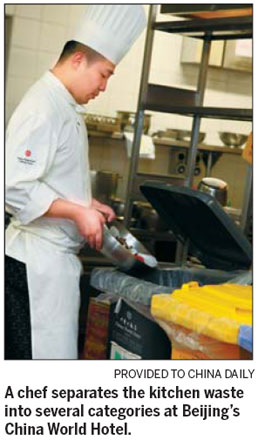
The hotel has three restaurants, a bar, two lounges and a staff cafeteria that holds nearly 2,000 people a day. The hotel creates more than 5 tons of kitchen waste every day.
Li points to a workbench in the kitchen where employees separate waste from the dinner tables into several categories.
"We sort bottles, paper, chopsticks and other recyclables out of the food waste," Li explains.
Various types of garbage are put into different colored cabins. The food waste goes into a black bin and is put underground cold storage.
Chaoyang district's government sends a garbage truck to collect the hotel's kitchen waste at about 4 pm every day.
China World has also invested in dehydrators to dispose of food waste before the trucks arrive.
However, not all restaurants dispose of waste in the same way.
Zhao Bin runs a restaurant in Beijing's Liangmaqiao area, which can hold about 50 people. As the government-operated kitchen waste collection hasn't extended to small restaurants, he has to deal with it in other ways.
"The government requires us to separate kitchen waste," Zhao says. "However, I really don't know how to handle it all by myself."
Consequently, Zhao uses private collectors. A minibus will come to his restaurant every day at 10 pm to take the waste away, charging just 10 yuan ($1.50).
"These collectors come from nearby provinces. I don't know exactly how they process the waste."
The Beijing Municipal People's Congress passed a bill in November 2011 to better manage the capital's garbage disposal. Confronted with the public's rising concerns about "gutter oil", the bill emphasized the construction of kitchen waste disposal facilities and regulation of kitchen waste collection.
Chen Ling, an official in charge of garbage disposal at the Beijing Municipal Commission of City Administration and Environment, says the municipal government will promote the use of kitchen waste disposal machines among restaurants and offer technical guidance.
"It's very urgent, and we expect all kitchen waste in Beijing will be correctly disposed of soon," she says.
"It's essential to erase waste at its source. We'll encourage people to be more conscious about waste and avoid producing unnecessary garbage."
According to the new bill, which will come into effect in March, the more waste created, the more money will be charged.
"The simplest way is to avoid ordering too much food," Li says. "Chinese people like luxury banquets, but maybe it is not a good habit. Our waiters will kindly remind the customers when what they have ordered is enough. It saves money on both sides."