A master class from China's dancers
Updated: 2012-01-20 11:03
By Pauline D. Loh (China Daily)
|
|||||||||


Review
Tibetan folk dances, traditional Mongolian themes, dances inspired by classic figures from history and literature - they were all onstage at the National Center for the Performing Arts' Gala of Dance last weekend.
It has become an annual tradition for the NCPA to pay tribute to the masters of dance as the end of the lunar year draws near, and this year was no exception.
At a glittering gathering, each act shimmered with creativity and mastery. Supple bodies and expressive moves represented the best of dance in China.
Many of the performers were young, but there was one star who stood out.
Yang Liping, China's deity of dance, rewarded those who supported the event with her Moon Dance. Hers was the penultimate act. But the audience, having sat through a program with no intermission, sat up, stood up and gave her thunderous applause.
Yang simply outclasses other dancers. She never moved more than two steps on the podium, and we never saw her face. She was silhouetted against a giant moon that dominated the stage. And yet every muscle in her body, including her famous fingers, exuded the spirit of dance.
At the end of the evening, my husband turned to me and said: "It was worth every cent we paid. But I think we paid 500 yuan ($79) to see Yang Liping."
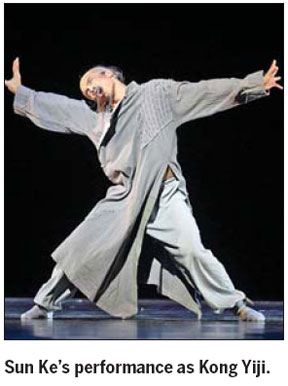
Our tickets were 680 yuan each. Following this theme, perhaps the next 100 yuan went to Sun Ke's performance as Lu Xun's tragic-comic character Kong Yiji, the impoverished scholar caught in a historical transition he did not understand and could not fit in.
From the initial clownish moves to the final stumbling that brought out the pathos of Kong Yiji's life, Sun Ke was fully in character, and I found myself moved and wet-eyed. To be able to convey such drama in dance, Sun more than deserves the 100 yuan we awarded him.
This does not mean the rest of the dancers were mediocre. They represented the cream of the crop, the best of the best.
Another dance that drew inspiration from literature was Tears from the Phoenix by the Sichuan City Culture and Arts College. Their creative source came from Ba Jin's famous Family trilogy, which described the stifling rituals of feudalistic family pretentiousness and hypocrisy hidden under a veneer of propriety.
A wall of black-robed matrons formed a formidable backdrop for a maiden dressed in white. As the dance progressed, the black wall slowly stamped out and defeated her youthful exuberance. The solo was performed by Yu Erge, a graduate of the school and currently a teacher at the same college.
What made this an evening that celebrated dance in China were the efforts of the dancers and how they sought to merge folk traditions, history, literature and dance onstage. The elements were certainly all Chinese, and the chapters in this book are only just beginning.
We look forward to another evening, next year.