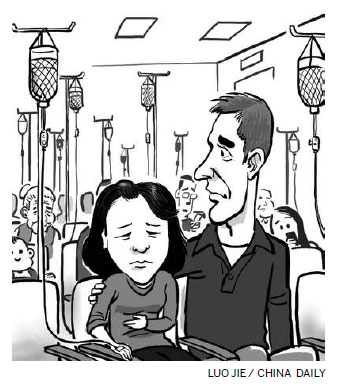
My first look into the Chinese medical system came six years ago, when my wife and I traveled to see family in her hometown in Changzhou, Jiangsu province.
She developed digestive problems one night, and we headed for a large local hospital. A doctor ran her through a stomach X-ray and various other tests.
I'm not sure of the exact diagnosis, but it amounted to, "You sampled food from one too many street stalls."
Perhaps she'd been away from China for too long and lost some immunity.
He sent us to a room with row after row of plastic chairs - maybe 100 seats in all - and racks overhead to hold IV bags.
About a dozen patients sat quietly with family members as the fluids drained in. How strange, I thought, to have an entire ward for food poisoning.
Since then, I've accompanied family and friends in various healthcare settings in China, including adult hospitals and clinics, a children's hospital and a plastic surgery clinic.
What I've learned: If you go for medical care in the Middle Kingdom, you are getting an IV.
It's the treatment of choice not only for food poisoning but for flus, colds and other ailments, large and small.
A typical Chinese person, my wife tells me, might get a couple of sessions of intravenous fluids a year.
Even dentists prescribe IVs, sometimes. It's not always obvious to the patient what's in the bag.
In the United States, on the other hand, intravenous fluids are mostly for seriously ill patients, usually those who are staying in the hospital or are in the emergency room. For small stuff, most people I know make do with cold tablets and bed rest - or, increasingly in the bad economy, a regular day at the office.
To learn more about the gap in medical cultures, I called Dr Peter Liu, who has worked in both medical cultures, having trained in China before emigrating to the United States.
"In China, a lot of people think an IV gives you all the nutrients and treatment you need," he says.
"If you don't put patients on it right away, they get upset."
The most common IV, he says, is saline, which is reflected in the common term for the treatment, gua yan shui,or "hang salt water." The bags can also contain glucose, vitamins or antibiotics.
If the patient doesn't need the IV, sometimes the doctor will set it up anyway and make the drip very slow, Liu says. In those cases, about all they're getting infused with is the placebo effect.
The drip bag can be a quick way to re-hydrate a patient or get a medication started. The instant gratification is probably why it's so popular.
But the method also carries risks. Patients who haven't been checked for certain preexisting conditions, such as congestive heart failure or kidney failure, might not be able to handle the extra fluids and could die, Liu says. And piercing the vein can open the door for pathogens to enter the bloodstream.
In his practice in Lexington, Kentucky, Liu orders IV fluids only when the patient - suffering vomiting and diarrhea - cannot otherwise retain liquids. Otherwise, he instructs them to drink plenty of water or sports drinks.
My wife left the IV room feeling much better after three bags in as many hours. Since then, she has even finagled a couple of IVs in the United States from somewhat puzzled doctors who, like those in China, want their patients to be happy. But for most common illnesses, we rely on the age-old American remedies: Tylenol and the passing of time.
"I tell colleagues in China that some IVs are probably doing more harm than good," Liu says.
"They say, 'What do you expect us to do? The patient and family will think we're not treating them right'."

|
|
|
|
|
|
|
|

Copyright 1995 - . All rights reserved. The content (including but not limited to text, photo, multimedia information, etc) published in this site belongs to China Daily Information Co (CDIC). Without written authorization from CDIC, such content shall not be republished or used in any form. Note: Browsers with 1024*768 or higher resolution are suggested for this site.
License for publishing multimedia online 0108263 Registration Number: 130349 



















 Raymond Zhou:
 Pauline D Loh:
 Hot Pot
 Eco China
 China Dream
 China Face