Money worth more than what's it's printed on
Updated: 2012-01-11 10:20
By Cheng Yinqi and Guo Anfei (China Daily)
|
|||||||||


 |
|
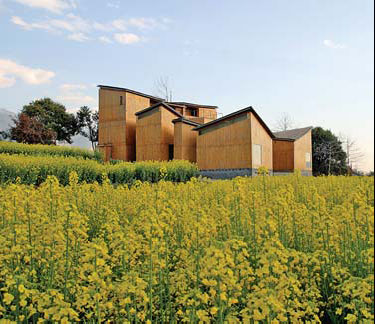
Xinzhuang papermaking museum borders a field of rapeseed flowers. Provided to China Daily |
Editor Long Wen believes his investment in a museum in Yunnan province's remote Xinzhuang village is worth more than the paper it's printed on - its value is the preservation of the local papermaking skills that villagers kept secret from the Ming Dynasty (1368-1644) until 2006.
The 35-year-old says he doesn't intend to profit from the admission-free museum.
"I don't plan to even recover the costs," he says.
"Our efforts are entirely to protect the papermaking tradition and local lifestyles."
The museum is located in the village at the foot of the Gaoligong Mountains - two hours' drive from the nearest tourist route. It's mostly finished, but some details need to be taken care of before it opens.
Long first visited Xinzhuang in 2003, while researching Gaoligong's intangible cultural heritage. He was surprised to learn half the villagers were making paper by hand and that half also share his surname.
"The villagers' forefather came from Hunan province, like mine did," he says.
"There's a decent probability we share the same ancestor. I believe my arrival in Xinzhuang is fate."
Frontiersman Long Lin migrated from today's Hunan province to found Xinzhuang about 600 years ago. He is believed to be the source of the papermaking skills that have been passed down to the village's 350 households.
"We've passed it down to male family members for centuries, just like kungfu," 55-year-old villager Long You'en says.
"But this tradition has changed."
Long Wen became concerned about the threats modernization posed to Xinzhuang's papermaking.
He believes the perils were similar to the situation of dongba paper made in Yunnan's Lijiang, which also was created by a secret process and was once considered the world's most expensive paper. But an abundance of fakes pushed authentic producers out of business.
"I had to do something," Long Wen says.
"A business association is the best way to ensure the traditional skill's continuity. Building a workplace for the association was the driving vision behind the museum."
Long Wen joined forces with his friend Wang Yan, who runs a design company in Beijing. Wang helped renovate an old house in the village into the museum.
Wang introduced Long to his friend, Beijing-based architect Hua Li, in 2006. They asked Hua for renovation suggestions.
"I became interested in the project at first sight," Hua says.
"But their plan couldn't work, because the ancient house couldn't provide enough lighting and good exhibition spaces."
Hua visited Xinzhuang for a week in April 2008 to research local construction methods, building materials and skills.
"Because the idea behind the museum is to protect tradition and promote community development, I wanted to use local resources as much as possible, from materials to builders," Hua says.
Hua returned to Beijing to develop a final design, but the actual construction didn't go as smoothly as expected.
"I used local construction methods employed to build wooden houses, but a museum's form and function require modern elements," Hua says.
"Even the village's most skillful craftsmen didn't know how to handle some details."
The remote village didn't have waterproof materials or glass for windows, so these had to be found in Tengchong city.
And because the builders were farmers, they could only work for a part of the year and had to tend to their crops for the rest.
"The work should have been completed in six months, but it lasted from May 2009 until this year," Hua says.
"The prices of labor, wood and other materials have grown, so the construction costs increased to almost three times the initial estimate."
But Hua has found innovative ways around these problems.
To save money and display handmade paper, he used 45-cm-by-45-cm sheets to cover the interior walls. These can be changed, backlit or scrawled upon with calligraphy.
Wang points out the paper's durability is among its best features.
"Paper created using modern methods usually becomes fragile in half a century because it's too acidic," he says.
"Xinzhuang's paper used for local official documents centuries ago remains soft today. If we find a way to improve and standardize the quality, we can probably discover better uses for paper than making funerary money."