Beijing's black market alchemists
Zhao Dapeng has spent the last 11 years illegally soliciting used electronics door-to-door - earning more than he can farming in Henan province and more than Beijing's licensed e-waste recyclers.
"Broken or just old, be they computers, TVs or cell phones, I scrap them," the 42-year-old says.
He earns three times more collecting e-waste than he did growing corn and wheat in his hometown, he explains.
That's even after copper's price plummeted from 60 yuan ($9.44) in 2007 to 25 yuan per kilogram now.
"I felt the pressure from the slowing global economy even before Beijing hosted the Olympic Games," Zhao says. "The financial crisis has made everything cheaper."
He pays 300 yuan ($46.40) to 500 yuan per laptop and about 100 yuan per desktop. He gives sellers 5 percent of the market value of a mobile phone.
During the peak season - just before university graduations, when students are most likely to shed their gadgets - he can buy more than 10 computers and 30 mobile phones a day.
Winter is bad for business.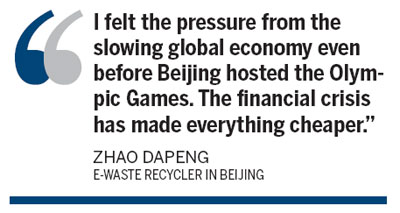
"Sometimes, I come home empty-handed," he says.
There are more than 170,000 illegal e-waste recyclers like Zhao in the capital, Beijing Municipal Commission of City Administration and Environment engineer Wang Weiping estimates.
Recyclers prefer to work with black market workshops, Wang explains.
"They offer higher prices, so they command the top of the industrial chain," he says.
"That makes them competitive with qualified recycling companies."
Companies like Beijing Huaxing Environmental Protection Development Co, Ltd - one of two certified e-waste processor in the capital - know this well.
"We can't even begin to compete with illegal collectors," Huaxing's president Zhang Jun says.
The government-mandated e-waste disposal plant previously couldn't even bring in enough refrigerators to reach its annual capacity of 2 million.
But the experimental facility exceeded that by 1.5 million in 2010, thanks to a government home-appliance replacement initiative started in mid-2009.
The program offers subsidies of 200 yuan to 400 yuan for purchases of five designated products - televisions, computers, air conditioners, refrigerators and washing machines. Buyers swap their old electronics and appliances for new ones.
Huaxing has signed recycling agreements with such electric appliance supermarkets as Suning and Gome. The plant receives up to 70 percent of its e-waste from these stores.
More than 80 percent of these retailers' used appliances previously went to illegal dealers.
However, Huaxing operates eight assembly lines for refrigerators, air conditioners, TVs and desktops. And it can't dispose of laptops.
But the number of e-waste units in the capital exceeds 8 million a year and has continued growing at an average of 5.2 percent for several years, government figures show.
Part of Huaxing's dilemma is the Beijing Resource Recycling Association has set e-waste purchasing prices lower than what illegal collectors pay.
So, the certified plant offers 30 yuan for a desktop and requires sellers to call and make an appointment for pickup, while Zhao goes knocking on doors buying all kinds of e-waste for three times the money.
Zhao agrees the industry needs a new legal foundation.
He chose his trade after settling in Beijing without skills, outside of agriculture.
"E-waste recycling has a very low barrier for entry and provides flexible hours," he says.
At dusk, he returns to Beijing's Houbajia village, where nearly two-thirds of 360 households deal in illegal e-waste. The guts of used gizmos are heaped outside of the settlement's houses.
His wife sifts through parts for usable components in the 20-square-meter room he rents for 200 yuan a month.
Functioning pieces are used to assemble "secondhand" computers sold in the capital's Zhongguancun electronics market. The rest will be shipped outside of Beijing to be melted and mined for valuable metals.
When the couple has enough to fill a truck, they hire one to take the e-waste to Changping district's Dongxiaokou village - an e-waste storage destination that is the second link in the industry's commodity chain.
Zhao refuses to reveal the next stop or his buyers.
"Some e-waste dealers in Guangdong province's Shantou city rent big storehouses and send the materials to (Shantou's) Guiyu town," he says.
He reveals circuit boards usually sell for 30 yuan a kilogram in Beijing but become worth 50 yuan once they reach Guangdong.
"Our buyers, though, are secret," he says.
"Dealers are competitive. So we don't reveal our purchasers or prices."