Let there be light
Updated: 2011-10-24 14:52
By Liu Yujie (China Daily)
|
|||||||||


 |
|
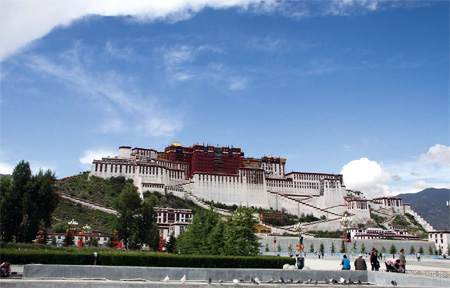
The magnificent spread of the Tibetan temple complexes forms part of the unique landscape and resembles a small city on the hill. |
 |
|
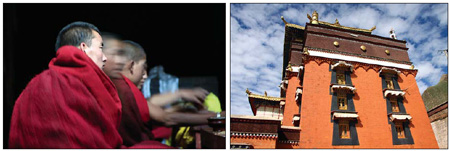
The maroon robes of the monks are bright spots of colors contrasting with the deep ochres and burnt gold of the monastery walls. Photos by Liu Yujie / China Daily |
One of the best ways to experience a new place is to understand where the people live. Liu Yujie looks at how Tibet's religious and secular complexes give the land its exotic aura.
Every traveler dreams of going to Tibet, saying it is a holy place that will purify your heart. When I finally went, I realized how the architecture helps Tibet maintain its reputation.
Courtyards and their unique color combinations are the most prominent features of Tibet architecture, seen in both its Buddhist palaces and monasteries and in its ordinary houses. But there is also the play of light, both within and without the complexes.
When we were taken on a half day's visit to Drepung Monastery 5 km outside of Lhasa, this largest of all the Tibetan monasteries showed off the classic charms of the Tibetan courtyard structure.
A slow climb up the mountain path, and the vista opened up to a broad, luxurious view of the whole temple complex, which spread out towards the sun, its buildings nestled close to one another, on top of one another. It was like a small city on the hill, and it can take your breath away, and not because of the high altitude.
From a distance, it looked as if it could sit on the palm of my hand, but as we moved closer and stepped inside the gate, I felt I could get lost very easily within the maze.
The monastery is home to hundreds of monks who study and live here just like at a university. Dim corridors connected room to room, with none alike, which made it rather hard to get my bearings for a complete floor plan.
Some rooms have no windows and rely totally on candlelight, and the smell of the burning wax was so pungent that it could make you dizzy.
Unlike Chinese traditional compounds that emphasize strictly symmetrical layout, Tibet's temples, built around the courtyards on the hillside, adjust vertical levels and horizontal axes to fit the changing slopes. Within an hour, I had reached the middle of the mountain without even realizing it.
It was an astounding view, with the toy-like houses and stairs spreading out below.
Perhaps the reason why almost all the buildings in Tibet are self-enclosed and only open to the central courtyard is the harsh weather, especially the extreme cold and blustery winds in winter.
The courtyard is the only place in the compounds with natural light, and as you enter from the dimly lit interiors, the swift and sudden change can hurt your eyes. As we tunneled through nearly dark rooms and bright courtyards by turn, I could feel my pupils constricting and dilating, so much that I became almost hallucinatory and drifted between reality and dreams.
In the main halls of worship, bright shafts of light from glass panes in the ceiling shone on the Buddhist statues, creating the only bright spots in dark rooms. I noticed that whenever the devout prostrated themselves in prayer, the dust motes raised showed up parallel rays of light, almost like a laser display piercing the dense clouds of dust. I found such play on light in several other temples as well.
In Jokhang temple, the dimness inside is broken by rays that seem to spill from thin cracks and crevices along the walls and roofs, suggesting a capricious journey to Buddhist insight. The whole is accentuated by hundreds of flickering candles to the left of the statues, and it created a stage effect of immense power and nameless hope.
Likewise, light played in the square in front of the temple. Here followers burned dried grass in furnaces, creating a veil of dense smoke that permeated the whole square and hid parts of the temple. Perhaps the haze was a reminder to the devout that Buddha cannot be seen, but can only be felt in the heart.
It is the same with Tibetan temple architecture. It has an enchanting beauty that cannot be felt until you physically stand before it, and it is something that cannot come through mere photographs.
The purple-red and brown-yellow of the monks' cassocks add to the color spectrum. Together with the white walls and fiery red pillars of the temples, they present a flame-bright landscape.
Gold is also seen everywhere, mostly on roofs, as Sakyamuni, the founder of Buddhism, is believed to have golden skin. Looking from afar, the temples orchestrate red, gold, white and natural wood to such pleasant harmony that I could almost hear the singing in the air.
This close encounter with Tibetan architecture, to me, somehow embodies religion and aesthetics, and fully convinces me of the power they represent. Now I can understand why the devout come from so far away prostrating themselves on the ground all the way in continuous prayer. The temples stand in quiet testimony of their faith.