'Sharpen up' acupuncture study
Updated: 2011-09-26 10:34
By Shan Juan (China Daily)
|
|||||||||


 |
|
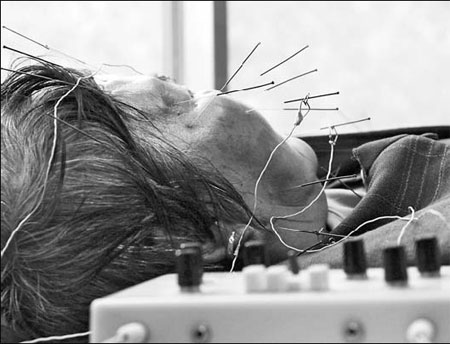
A patient suffering from facial paralysis receives acupuncture treatment at a hospital in Nanjing, the capital of Jiangsu province, on Dec 6, 2010. Zhao Qirui / for China Daily |
BEIJING - Although it is home to traditional Chinese medicine (TCM), China must do much more to improve its academic research capacity for acupuncture, a form of TCM, to take the lead worldwide on both the academic and clinical sides.
At present, among all academic theses on acupuncture indexed by the Science Citation Index (SCI), a leading world thesis index system, only 5 percent are from the Chinese mainland, according to Wang Linpeng, the director of the acupuncture and moxibustion center of the Beijing Hospital of Traditional Chinese Medicine, which is affiliated with the Capital Medical University.
Although Chinese acupuncturists absolutely excel worldwide in clinical practice, "they are not as good as their foreign peers in academic capacity, particularly Western-style research methods and lab experiment design," he told China Daily on Friday during the 2011 International Symposium on Acupuncture.
Studies by TCM practitioners - including acupuncturists - largely focus on their area of specialization, and few are in line with global interest in the medical science that has been proven effective over thousands of years, he said.
"Chinese TCM practitioners are very good at treating conditions, but they are clumsy at showing how and why it really works in an internationally accepted 'language' and 'manner'," said Gao Sihua, chancellor of the Beijing University of Chinese Medicine.
"It's especially true in TCM circles, where few Chinese practitioners would regularly follow international academic articles and research trends," Wang said.
Measured by the number of articles on acupuncture indexed by SCI, the US and European countries lead globally, he said.
If nothing changes, it could be that in 30 years, the Chinese would have to learn from foreigners about TCM, warned Wang Guoqiang, who heads the State Administration of TCM.
In Wang's opinion, the issues foreign experts study when it comes to acupuncture are quite basic for most Chinese researchers.
"They just know better about the lab research design and methods," he said.
Chinese are also capable of doing high-level research into TCM including acupuncture, up to internationally recognized standards and having more theses indexed by SCI, he said.
Some TCM experts have warned that following this course could hurt TCM's characteristics. Wang, however, disagreed.
"Explaining well why and how TCM works internationally also helps Chinese researchers deepen their understanding of the medical science," he said.
Nicola Robinson, editor-in-chief of the European Journal of Integrative Medicine, urged Chinese TCM experts to do more research into TCM based on lab evidence.
Although it is practiced in more than 160 countries, acupuncture has not been integrated into national health services in most of these countries, largely because the lab-based evidence is not good enough, she said.