Scroll depicts official revelry 1,000 years ago
Updated: 2011-09-20 11:22
By Cheng anqi (China Daily)
|
|||||||||


 |
|
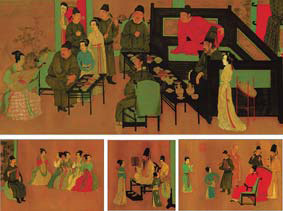
Parts of The Night Banquet of Han Xizai, in the collection of the Palace Museum in Beijing. Provided to China Daily |
Han Xizai, a high-ranking official of the Southern Tang, a kingdom of the Five dynasties and Ten Kingdoms (AD 907-960) period, was a talented man, but given to sensual pleasures.
He kept a number of singers and dancers to entertain guests at his nighttime revelries.
When he turned down emperor Li Yu's offer to be his prime minister, Li was curious to know what it was that Han desired so much that even such a high position in his court could not tempt him.
So the emperor sent his court painter Gu Hongzhong to spy on Han and the picture that Gu painted of what he saw is the well-known masterpiece, The Night Banquet of Han Xizai, which has been handed down intact.
The scene depicted in this artwork has since appeared on a number of replicas and has even been adapted to the stage.
The painting, 333.5 cm long and 28.4 cm wide, is housed in Beijing's Palace Museum.
Han, the main subject of the work, appears in five interrelated yet independent plots and scenes in the long scroll.
The first composition shows Han (upper right) listening to the pipa,or Chinese lute. He is the bearded man in a tall hat seated on a couch, his head slightly lowered and his hand hanging over his knee. Apparently weighed down with anxiety, he is only half-listening to the music.
This is in contrast to the red-robed man, Lang Can (upper left), the scholar who has taken first place in the imperial examinations. He has an easy manner and is enjoying the music, and watching the woman play the pipa.
The placing of the performers on one side and the audience on the other underscores the theme of the composition, which is the enjoyment of a musical performance.
The individual response of the listeners, of different ranks as well as temperaments, is carefully depicted.
It shows the close attention the artist paid to every minute detail and his superb drawing of human figures.
In the second section, Han is shown playing the drums for a dancer. Sitting in front of the drum, Lang remains totally absorbed in the proceedings.
The others, all in a joyous mood, keep up the beat with clappers or their bare hands. Only the monk De Ming, Han's friend, in the background, looks pensive.
The incongruity of the monk's presence amid the merry-making is obvious enough, even without his austere manner.
The fact that the artist has chosen to include him has a deep significance.
It is believed the monk asked Han why he spurned the offer to serve his country. Han replied that with the North enjoying growing strength and influence over the South, the South would eventually fall into disarray.
"I will not be the prime minister of a decaying state. I don't want to be scorned by posterity," Han said.
The monk's meditative mood amid the revelry is, however, probably more indicative of his brooding over the impending doom of Southern Tang.
The rest of the hand scroll includes the following scenes: taking a rest, where Han is shown washing his hands in a basin held by a maid; a performance by flute-players with Han listening; and seeing the guests off, in which flirtatious exchanges between the guests and the women entertainers are depicted.
The painter uses the continuous narrative method and employs screens and instruments to connect and separate different sections. In each of the five episodes, Han is the main actor, who having no trust in the emperor, chooses to escape the reality through song and dance.