Putting an end to poverty
Updated: 2011-09-13 13:41
By Erik Nilsson (China Daily)
|
|||||||||


 |
|
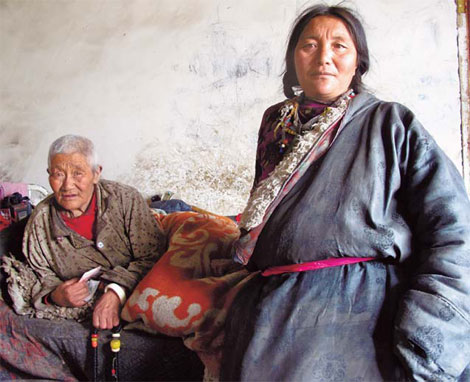
Raxima (left) and her widowed daughter Lhamao in their earthen dwelling. |
Since Raxima is paralyzed, she says she couldn't get out of bed to get a knife and end the burden she believes she puts on her family.
So the 79-year-old tried opening her wrists with her teeth, she explains, pulling back her sleeve to reveal an arm pocked with oval-shaped bite marks.
"We don't have enough money or food," she says. "What we have should go to the boy, not to me. My siblings have left this world. I should join them."
Raxima believes it's "too much" for her widowed daughter, Lhamo, who has cared for her uncle's 7-year-old orphan Tseringdongzhub since he was 1.
"My daughter can't work," Raxima says. "That's largely because I can't even go to the bathroom without help."
The only work 48-year-old Lhamao can do in Qinghai province's Yege town - a remote community of about 2,000 nomadic yak herders in Qinghai's Yushu prefecture - is collect dung.
It is used for heating and cooking in the Tibetan Plateau settlement, where most inhabitants live in tents and winters can reach -25 C.
But dung collectors like Lhamao can earn a few hundred yuan a year at most and the family survives largely on the kindness of community members. The earthen dwelling they call home this year is on loan from neighbors.
"Sometimes, if others have extra food, they'll share with us," Lhamao says. "The government gives us some flour, samba and oil. But it's not enough."
They say they spend any money they get on clothes for the boy.
Most of the money, however, is required for food because they don't own any livestock, Lhamao says. Yak dairy is the only source of food for many nomads in Yege.
"We haven't eaten meat this year," Lhamao says. "We've never tried a vegetable or fruit. We just eat rice and flour. That's all.
Because there is no electricity, they have to borrow money for candles.
"If we had a solar panel, the boy could study at night," Lhamao says. "And we could see after dark. Life would be better."
The hundreds of yuan they must spend on candles has put Lhamao's neighbors Qiunang and Kyitso in debt, too.
They were both born with a mental disability that makes it impossible for them to learn how to count. Their knowledge about their own finances comes from what others tell them, they explain.
The parents are grateful their 7-year-old daughter Suojankazhu has no disability, as Qiunang, 30, was born with disabilities in his right hand and left foot. His 29-year-old wife, Kyitso, is the only family member who can work.
She earns up to 4,000 yuan a year herding wealthier households' yaks and sheep, and collecting dung.
"But I can only work for four months a year," Kyitso says. "There are no jobs when the herding season is over."
The couple owns three yaks.
"They provide us with milk and butter but no income," Qiunang says.
They believe an 800-yuan solar panel could be the solution to the debts they incur buying candles.
"The solar panel would be cheaper in the long run," Qiunang says. "But we never have enough money at one time."
The family spends about 3,000 yuan a year on Kyitso's liver disease, she says.
"We can't afford clothes," she says. "What we're wearing came from others. But they're not enough. We're cold in winter."
The two families live in Yege's Hongqi village, a cluster of 131 earthen dwellings and tents that are home to 480 herders, who earn an average of about 1,500 yuan a year, village chief Kangia says.
"The poorest people think that if they can eat, everything is OK," he explains.
"A lot of the people work for one day, take the money and buy instant noodles. The next day, they wake up and think of another way to feed themselves."
Kangia says the government provides villagers some food and housing but no regular cash allowances. It gave Hongqi money twice - 5,000 yuan ($782) one year and 7,500 yuan another year, he says.
"It tries to help them, but there are too many poor households and not enough money to go around. One year, they'll help one family. The next year, they'll help another."
The families of Lhamao and Kyitso say they aren't sure if they can get food or housing assistance next year.
They believe their best chances of better futures rest in their children.
"We're very happy our girl can read and get an education," Qiunang says.
"If someone can help us pay for it, we hope to send her to university. Then, maybe, we could live more happily."