Broken plate puts spotlight on Ge ware
Updated: 2011-08-23 09:19
By Zhang Zixuan (China Daily)
|
|||||||||


On July 4, the sound of porcelain cracking ripped through the silence of the Palace Museum.
The plate that broke was no ordinary one, but a first-class national treasure dating back to the Song Dynasty (960-1279).
Called Celadon Plate with a Mouth in the Shape of Mallow Petals, it broke when a researcher doing a pressure test on it made an error adjusting the testing device.
Although the Palace Museum promised the plate could be repaired, it drew much flak from the public.
"The plate is worth at least 20 million yuan ($3.12 million)," says Ma Weidu, curator of Guanfu Museum and a renowned collector.
The plate is part of the renowned Ge ware porcelain.
Of the five major kilns of the Song Dynasty (960-1279) - Guan, Ge, Ru, Ding and Jun - works from the Ge kiln are the most precious. Even the kiln site is yet to be identified with any accuracy. Only around 100 pieces of Ge porcelain ware are believed to exist in the world.
Ge porcelain comes in several colors such as black, dark gray, light gray and yellowish brown, and is usually covered with a bluish-gray glaze.
A distinctive characteristic of the glaze is the jin si tie xian, or golden floss and iron threads, which refers to the two sets of crackles, one of darker color interspersed with the other of fine yellow lines.
The crackles are formed by the different rates of expansion of the body and the glaze. During the cooling process, the glaze crackles as it shrinks more.
Ge ware was once directly supervised by the Song court; today, the majority of Ge artifacts are to be found in the Palace Museum in Beijing and the Palace Museum in Taipei.
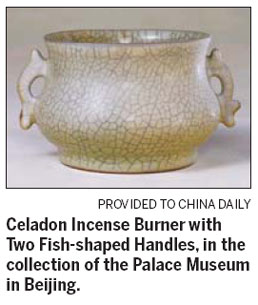
Like the damaged plate, the Celadon Incense Burner with Two Fish-shaped Handles is also a first-class Ge porcelain treasure.
The burner is shaped like a bronze gui vessel, a food container sans cover or handle, used as a ceremonial object in the Shang (c. 16th century-11th century BC) and Zhou (c. 11th century-256 BC) dynasties. Its S-shaped body, covered with a light blue glaze and the typical "golden floss and iron threads" crackle pattern, has two symmetrical fish-shaped handles.
Although many imitations followed in the Yuan (1271-1368) and Ming (1368-1644) dynasties, none can compare with this masterpiece. Emperor Qianlong of the Qing Dynasty (1644-1911) even composed a poem in the spring of 1776 and had it carved on the base of the burner.