Mixed marriage, with more acceptance
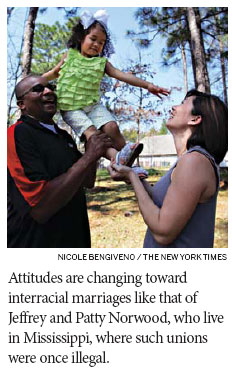
For generations here in the deepest South, there had been a great taboo: publicly crossing the color line for love. Less than 45 years ago, marriage between blacks and whites was illegal, and it has been frowned on much of the time since.
So Jeffrey Norwood, a black college basketball coach, had reservations about taking a job in Mississippi. He was in a serious relationship with a woman who was white and Asian.
His father, recalling when a black man could face death being seen with a woman of another race, asked, "Are you sure?"
But on visits to Hattiesburg, the younger Mr. Norwood liked what he saw: growing diversity. So he moved, married, and, with his wife, had a baby, who was counted on the last census as black, white and Asian. She is one of thousands of mixed-race children in this state, one of the nation's most rapidly expanding multiracial populations, up 70 percent between 2000 and 2010, according to new data from the Census Bureau.
In the first comprehensive accounting of multiracial Americans since statistics were first collected about them in 2000, reporting from the 2010 census shows that in North Carolina, the mixed-race population doubled. In Georgia, it grew by more than 80 percent, and by nearly as much in Kentucky and Tennessee. In 2000, seven million people - 2.4 percent of the population - chose more than one race in the census.
In California, Hawaii and Oklahoma, the increases were smaller than in places like Mississippi, where there were far fewer mixed-race people to start with.
Mississippi led the nation in the growth of mixed marriages for most of the last decade, said William H. Frey, a demographer at the Brookings Institution, a public policy organization in Washington, D.C.. Still, multiracial people are a tiny percentage of the state's population: 34,000, about 1.1 percent. And many here see enduring racial inequities. Still, many also see progress.
Mr. Norwood and his wife, Patty Norwood, a photographer, are among them. "It's been really smooth here," said Mr. Norwood, 48, a Hattiesburg resident for 11 years.
And unlike in many states, Mississippi's population has not grown much over the last decade, suggesting that any change in culture is happening not primarily as a result of newcomers.
Much of the growth in the mixed-race group can be explained by recent births. But in Mississippi and in other states, some growth may also be a result of older Americans who once identified themselves as black or some other single race expanding how they think about their identity.
Mixed marriages are also part of Mississippi's coastal culture, which has historically been more liberal than the rest of the state.
Sonia Cherail Peeples, who is black, and her husband, Michael Peeples, who is white, met as students at the university in 2003. His family was "old Mississippi." Sonia Peeples's ancestors were too, but they were sharecroppers.
"I really never thought twice about it," Mrs. Peeples, 29, said of dating Michael, 30. "Everyone was open to it." They have two boys: Riley, 3, and Gannon, 5, who Mrs. Peeples likes to say are "black, white and just right!"
Still, another parent asked if Gannnon's allergies had something to do with "race mixing." And there was the hospital worker who treated Mrs. Peeples as though she were trying to snatch a white baby when she took the blond Riley out of his crib. But those few incidents seem insignificant in comparison to what previous generations endured.
"My 5-year-old asks, ??People who looked like you, why did they treat them so bad?'" Mrs. Peeples said. "It's hard to explain to a biracial child in 2011. In a perfect world, race wouldn't matter, but that day's a while off."
But it may be closer at their church, where the pastor is white, the assistant pastor is black, and the creative arts pastor is Latino. Growing up in Texas, Mrs. Norwood, 39, said she was never quite sure what race to mark on forms.
"Our daughter's life will not be like that. She knows what she is," Mrs. Norwood said. "The times have certainly changed."