Ode to a writer
 |
|
Taiwan musician Lin Shengxiang will sing in the Hakka dialect for his mainland tour. Photos provided to China Daily |
Former Labor Exchange Band frontman and folk musician Lin Shengxiang highlights the works of Taiwan author Zhong Lihe on his upcoming mainland tour.
Taiwan folk musician Lin Shengxiang's upcoming mainland tour, The Land Is My Study, is just as likely to attract literature enthusiasts as music fans. Covering Beijing, Shanghai, Shaoxing, Zhejiang province, and Guangzhou, Guangdong province, from April 16 to 23, the tour presents a collection of Lin's songs inspired by the life and works of Zhong Lihe (1915-60), a Taiwan writer best known for his novels about southern Taiwan's farming communities.
These songs were released in 2010 on Lin's CD The Land Is My Study, which was praised by Taiwan music critic Ma Shifang as "certainly the one if there is only one album on the chart of 2010".
"Zhong is the quiet pride of Taiwan literature, and I hope to pay a tribute to him with my music, although it is a great challenge for me," Lin says.
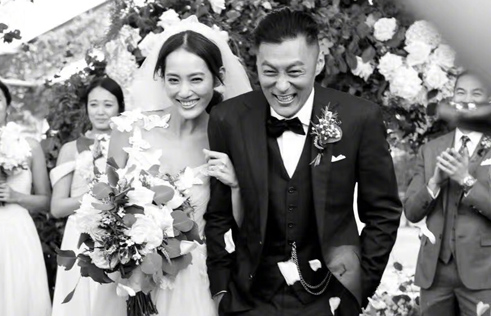
Zhong is known to many mainlanders through the 1980 film, China My Native Land (Yuan Xiang Ren), which was adapted from Zhong's novel of the same title and featured Taiwan film star Chin Han playing the role of the author. The film's homonymic theme song by Teresa Teng was also a hit.
"The blood of a person from a native land will only stop boiling when he returns to his native land," a sentence from the novel, was cited by Chinese Premier Wen Jiabao in 2004 when speaking about the cross-Straits relationship at a press conference.
Although Zhong was only 44 when he died of pulmonary tuberculosis, he is considered to be one of the most important writers from Taiwan, and China My Native Land ranked No 37 among the top 100 Chinese novels of the 20th century, in 2008, appraised by a jury of Chinese litterateurs from across the Straits and different countries and regions of the world.
Lin has a special emotional bond with Zhong's works, because he lives in the community that Zhong depicted in his novels.
Like Zhong, Lin is a Hakka from Meinong in south Taiwan. The Bamboo Hat Hill Farm, which was used by Zhong as the title for one of his most acclaimed works, is just a 10-minute drive from Lin's home, while Zhong's wife used to live in the same village as Lin before she died a few years ago.
Lin remembers clearly when he was a child, his mother carried him and his three siblings on a motorcycle to see the film China My Native Land, in town. It was his first cinema experience, and he could recognize the sites where many of the scenes were filmed, like the fruit market and the tobacco and liquor store.
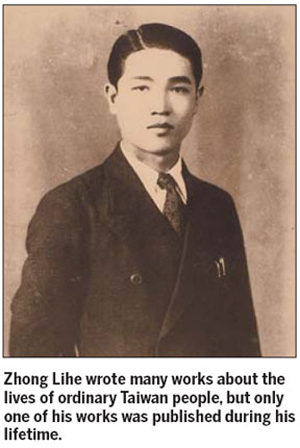
Zhong was from a well-to-do family, but he fell out with his family when he was young, and for the most part lived a poor and illness-plagued life.
Based on his experiences, Zhong wrote plenty of works about the lives of ordinary Taiwan people, especially farmers. However, only one of his books was published during his lifetime, while most of his works only became known after he died.
"I have become more and more fond of Zhong's works after re-reading them over the past few years," Lin says. "Zhong's works are not sensational, but they deal with humanity in a subtle way. The more the time that has passed, the greater his works seem to be."
The Land Is My Study, the title song of Lin's new album and tour, tells about the last decade of Zhong's life, when he lived in a humble cottage at the foot of Bamboo Hat Hill.
In 1957, Zhong wrote in his essay My Study how for many years he had neither a study nor writing desk, until, "One winter's day when the long shadows of the papaya trees came across the terrace, those cool dark patches gave me an idea. I took a rattan chair outside, plus a small round stool on which to place paper and ink and so on. And so I began to write".

From his vantage point Zhong had a commanding view of the hills and streams, the fields, the villages, the mists, bamboos and trees, and the people. And he wrote: "The land is like a green ocean. And if it happens to be a busy time on the farms, then it is dotted all over with busily wriggling figures. They are digging away at the land in search of human sustenance. It is a scene of tense activity, but a peaceful one; a scene of industry but also of joy."
Zhong's life stories are revealed also through other songs on the album. Little Sister, Come With Me tells how Zhong and his wife's marriage was opposed by their families because they had the same family name, and how they escaped to the mainland to pursue the freedom of love.
Forest Fire, based on a novel of the same title, describes the difficult circumstances of the Taiwan countryside in the 1940s and how people produced even more tragedies when they tried to move the gods by setting fire to the forest and destroying orchards that had taken years of toil to cultivate.
My Grandma From the Mountains is about Zhong's childhood memory of his aboriginal step-grandmother. On one occasion she took Zhong up into the mountains in search of a lost cow, and she suddenly seemed to grow younger and prettier because of the primordial atmosphere of the mountain.
The album was written by four lyricists, including Zhong's sons, Zhong Tiemin and Zhong Tiejun. All the music is composed by Lin, who has infused into the songs various elements he had grown up with - Hakka folk songs, Gezai Opera and aboriginal music.
Since the early years of his music career as the frontman of the Golden-Melody-Awards-winning Labor Exchange Band, Lin has been singing in his mother tongue, the Hakka dialect, including for The Land Is My Study. Lin believes that he can express himself better through Hakka, and the dialect is not that hard to understand for Mandarin speakers, if one gives it a try.
Japanese guitarist Ken Ohtake and bassist Toru Hayakawa recorded their parts and will tour with Lin. Apart from singing, Lin will play the yueqin, a traditional plucked instrument that Lin has modified.
While the program for his mainland tour will mostly feature songs from The Land Is My Study, Lin will also play a selection of his previous works, including some from the Labor Exchange era.
Besides giving concerts, Lin will also take part in a series of forums about music and literature, hosted by the Chinese Academy of Social Sciences in Beijing, Fudan University in Shanghai, and Xooyo Bookshop in Guangzhou.
"I'm thankful to Zhong Lihe for having brought such good literature works to the world, and I'm deeply proud to be a descendant of the people depicted in Zhong's works," Lin says.