Calm amid chaos
|
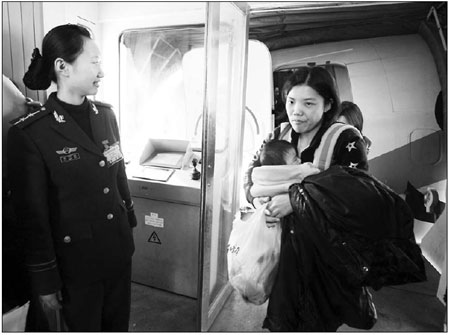
An aircraft carrying mostly Chinese passengers from Japan arrives in Jinan, Shandong province, on Tuesday. Chinese airlines have put on additional flights between China and Japan to meet the surging demand for evacuation. Gong Hui / Asia News Photo |
As Japan's quake crisis deepens, Chinese students and workers in the affected areas recount the help extended to them and the fortitude exhibited by the Japanese. Xu Lin reports.
For the past few days Li Qingda's life has felt like being in a Hollywood action flick ? surviving a 9.0-magnitude earthquake and escaping possible nuclear radiation. Li is a 21-year-old law student at Sendai's Tohoku University, located close to the epicenter of the earthquake that struck off the coast of Japan on Friday. It spawned a tsunami that swallowed up whole villages and towns, killing at least 3,600 people, with more than 7,800 still missing.
Sendai is 100 km north of the Fukushima Daiichi nuclear plant, where four explosions have triggered fears of a nuclear meltdown.
On Tuesday Prime Minister Naoto Kan urged that people within 20 km and 30 km of the plant remain indoors and be prepared for evacuation.
Amid the unfolding catastrophe, Li was struck by the exemplary behavior of the Japanese.
"The prices of goods remained the same. People continued to line up in stores and you could buy necessities even if you didn't have enough money," he says, adding that he was also touched by the many acts of kindness of the Japanese.
Li, who worked part-time at a McDonalds chain, said his Japanese manager - a Tohoku alumnus - offered to help him and said he could go to the store to have free meals.
To move farther from the nuclear power station, Li and his two Chinese friends took a cab to Yamagata, a county located about a two-hour drive from Sendai.
"But we did not have enough money. Luckily, the Japanese taxi driver only charged half the price," he says.
They arrived at Yamagata on Monday night and charged up his mobile phone battery for free in a karaoke pub.
"I don't know how to express my gratitude. Had the Japanese not helped us, we would have been in a worse situation," he says.
Li's plan was to go to Niigata and take the Shikansen bullet train to Tokyo to seek help from friends.
In the meantime, Li's father Li Guangqiang, a 48-year-old professor at Wuhan University of Science and Technology, had been desperately trying to contact his son.
After countless attempts, he finally got through and spoke to his son for the first time after the earthquake struck.
"He had just recharged his cell battery when I called him," the elder Li says.
Earlier, when Li Guangqiang failed to reach his son, he turned to Renren.com, a popular social networking website among Chinese students at home and abroad.
He left his son's name and contact details, along with others seeking to establish contact with relatives and friends in Japan, on its forum.
It attracted the attention of Zhang Hongzhi, who posted a reply saying he had finally reached Li's son after more than 40 failed attempts.
Zhang, 28, who has been in Japan for about seven years, works in an insurance company in Kyushu.
"I could hardly feel the earthquake in Kyushu. Besides donating money, all I can do is to help people contact their relatives and friends in Japan," he says.
The night the quake struck, he dialed dozens of numbers of other Chinese in the same situation from 8 pm to 2 am, in his bid to help people like Li senior.
"On that night, people abroad could hardly put through a call to Japan. The line here was very busy, too. To get through, I had to dial dozens of times," he says.
"I reached about a dozen people," he says.
Other Chinese people in Japan have also expressed amazement at the continuing social order in the midst of the calamity.
"They (the Japanese) are well aware that Japan is quake prone so when the quake struck they were psychologically prepared for it," says Shi Meimei, a 24-year-old student at Yokohama College of Commerce.
She also noticed that Japanese of all ages simply walked home when the tram system was suspended.
Yang Xu, 34, who once lived in Japan for several years and went back as a volunteer after the earthquake, says, "I met a 15-year-old Japanese girl who told us how she escaped the tsunami, gave us a big bottle of water and bowed deeply."
Yang says the freeway is only open to cars with emergency permits, such as the Self Defense Force, rescue teams, and construction and supply teams.
Meanwhile, the Chinese Embassy in Japan is evacuating Chinese from the quake-hit region to prevent their exposure to possible radiation leaks.
"There are about 400 Chinese students in Sendai. My friends tell me that the embassy is arranging flights for them to return to China," says Lin Wei, a 25-year-old at Tohoku University, who left for Nagoya after the earthquake.
Zhu Xingxin contributed to the story.
(China Daily 03/17/2011 page20)