Rite of birth
As the beginning rite of one's life, rite of birth consists of a series of ceremonies including praying for a son, fetus protection, labor, as well as three mornings, first month, first one hundred days, and one full year of a baby’s life, all directing at praying blessing for a new born baby and driving evil spirits away from the mother.
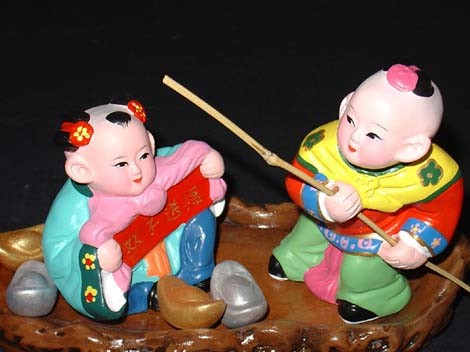 |
There are usually three manners of praying for a son: firstly, praying gods to bestow a son, namely, offering sacrifice to gods in charge of childbearing such as Kwan-yin, Bixia Fairy and Flowers God; secondly, praying for a son by eating food perceived to be able to foster pregnancy such as red painted eggs, lettuce and taro; and finally, praying for a son by giving out articles such as lantern, clay doll and kylin basin, which represent omen for acquiring a son.
Fetus protection is performed in the hope of securing the safety of mother and fetus during the pregnant period. Accordingly, top priority is usually given to the diet of the pregnant woman and prenatal education. Nutritious food such as meat soup, glutinous oil rice, vegetables and fruit is preferred for pregnant woman and some others carrying unfavorable meanings such as rabbit meat, ginger and sparrow should be avoided. To obtain good effect of prenatal education, pregnant woman should deep herself in good posture and mood, and stay in peaceful and harmonious atmosphere, and avoid wedding, funeral, ground breaking and other occasions.
 |
Rite of birth also includs "Three Mornings","Thirtieth Day","Hundredth Days" and "Grabbing Test".Rite of birth is an embodiment of people’s recognition of reproduction and their favorable expectation of life. Lots of customs involved in the rite are the embodiment of traditional Chinese culture.
Three mornings
"Three mornings" refers to the ceremony of birth held on the third morning after a baby is born. Red-painted eggs, fine dried noodles, seed cakes and other food will be sent by the baby's grandmother to celebrate its birth. Later, a ceremony of giving a bath to the baby on its third day came into being, in which the baby is given a bath using warm water boiled with herbal medicine and at the same time is blessed to drive off evil spirits.
The Thirtieth Day
On the thirtieth day after a baby is born, a head-shaving ceremony will be held, which is comparatively solemn among all the ancient ceremonies. In the ceremony the baby's head will be shaved by a barber who will then be given present from the relatives, and fetal hair of the baby will be put away or hung at the bedside.
The Hundredth Day
|
 |
On the hundredth day after a baby is born, ceremonies of meeting maternal uncle and naming are held with the latter as the principal aim. Auspicious characters such as "Gui'er" and "Xiang'er" (respectively means nobility and auspiciousness) are popular. It is also prevalent in some regions to select humble names or names with a meaning of invocations such as "Doggie", "Kitten" as well as "Suozhu" and "Shuanzhu" (respectively means lock up and fasten up). Moreover, it is a custom prevalent in South China to name a baby after its weight, such as "Seven Jin" and "Nine Jin" (respectively means 3.5kg and 4.5kg). There also exists a custom for the Manchu as to name a baby after the age of the Shaikh. For example, in case the grandfather is aged 88 when the baby is born, the latter will be named "Eighty-eight".
Grabbing Test
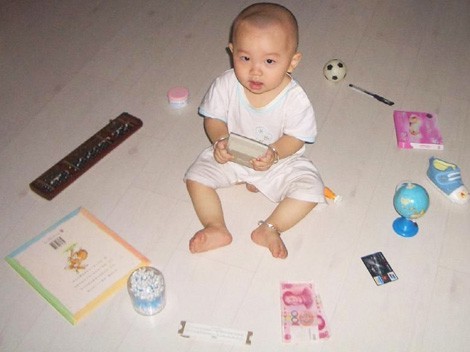 |
On a baby's one year birthday, a ceremony of grabbing test is held to forecast its disposition, ambition and occupation in the future. Articles used in the ceremony include book, pen, scissors, ruler, bread, apple, and rubber ball. In case the baby grabs a book or a pen, it is forecasted to enjoy reading after growing up. If it is a ruler or scissors being grabbed, the baby will be predicted to become a tailor; if food, a stodge; and if toys, fond of playing or fooling around. After finishing grabbing test, the host will give a banquet to friends and relatives coming to present with gifts and blessing. Dishes prepared for the banquet include longevity noodles and other food implying longevity. The rite of birth comes to an end after the banquet is finished.