Wenzhou wedding rituals
Wenzhou, a prefecture-level city in southeastern Zhejiang Province was once a prosperous foreign treaty port, and remains well-preserved today.
|
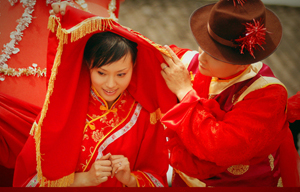 |
The Local Chronicles of Wenzhou record the city's often extravagant and always fascinating courtship and marriage rituals.
Proposal Ritual: kaihe
As a wedding is regarding as a fusing of two families, the kaihe, or initial marriage ritual, is a divination ceremony undertaken by both families to make sure the dates of birth of the prospective bride and groom mesh. The matchmaker brings to the groom's family a card inscribed with the prospective bride's birth date. They, in turn, ritually offer it to the kitchen god for three-to-seven days and invite a fortune-teller to divine whether or not the match is propitious. If all goes well, the bride's family asks the matchmaker to add the groom's date of birth to the card and return it to them. They repeat the divination rituals, and pray to Buddha. The card is then returned to the groom's family.
Betrothal Ritual: yipin and xiaoding
The kaihe ritual complete, negotiations over bridal payment and dowry begin, through the medium of the matchmaker. This is known as the yipin. General speaking, the higher the bridal payment, the bigger the dowry, which generally includes furniture and daily articles, such as a screen, table, cabinet and cupboards. The dowry of a bride from even the poorest of families always includes a chamber pot and a bucket.
After the yipin ritual has been completed, the groom's family presents gifts or xiaoding to the prospective bride's family. They usually comprise gold or silver rings, and four packets of wedding cake, chicken, goose, fish and pork. In return, the bride's family presents gifts to the groom's family of bowls and the fruits lichee, longan, and red dates. The pronunciation of "bowl" is the same as that for stability in the Wenzhou dialect, and signifies a lasting relationship. The groom's family keeps the bowls pristine until the wedding day.
Engagement Ritual: dading
The engagement ritual or dading consists of presenting dragon and phoenix marriage certificates that betoken the match to the bride's family. They keep one and, after signing the other, return it to the groom's family. This is a formal occasion upon which the two families officially acknowledge the marriage and give their blessing. The dading also fixes the date of the marriage. The bridal gifts and engagement dowry presented on this occasion are twice in magnitude those exchanged in the earlier xiaoding. Wealthier families display the bridal gifts and dowry in a downtown procession.
Pre-wedding Rituals: daijiajiu, shangtouli and song tangjinxing
The dading performed, both families officially announce the wedding to their relatives and friends, and prepare for the ceremony by performing the daijiajiu, and song tangjinxing rituals. One day before the marriage, the bride's family invites relations to feast on the presents of pork, mutton, chicken, goose and fish that the groom's family have presented. Each maternal relative receives a pomegranate-shape piece of candy, which signifies fertility and prosperity, in the ritual known as song tangjinxing. The candy is made from sugar simmered into a rich stock, shaped like a pomegranate and allowed to cool.
The ji ceremony was a rite of passage for young women aged 15 in ancient times. The ji is a hairpin bestowed upon a woman when she reaches marriageable age. One day before the wedding ceremony, the mother of the bride combs her daughter's hair and secures it with the ji. It is a custom known as shangtouli in the Wenzhou area.
Wedding Day Ritual: liujuyin
The liuju refers to the workers who make the items that comprise the bride family's dowry. They include the tailor, carpenter, painter, coppersmith and tinsmith. On the wedding day, these workers use red sashes to wrap the dowry, but traditionally leave certain main items, such as the closet until the groom's entourage gives them a cash incentive called the liujuyin to finish the job. Satisfied with the liujuyin they have received, the workers then proceed downtown with the dowry and on to the groom's house.