Travel
Gateway to the life of Rabindranath Tagore
By Chitralekha Basu (China Daily)
Updated: 2011-03-10 07:55
 |
Large Medium Small |
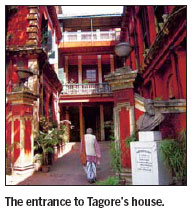
At the crossing of Chittaranjan Avenue - one of the main arteries cutting vertically across central Calcutta - and Dwarakanth Tagore Lane, a typically untidy and constricted tributary, stands a tacky terracotta arch. This is the gateway to Jorasanko Thakurbari (the house of Tagores of Jorasanko).
The bust of a long-haired, bearded man perched on top looks away indifferently, turning his gaze from the white smoke, spewed non-stop by heavy vehicles, and the mesh of electric cables, running horizontally, on all sides, splitting up the landscape in thin strips.
This is Rabindranath Tagore (1861-1941) - poet, artist, educationist and visionary, commonly recognized as the voice of the East in the early 20th century. And the lane beneath his gaze leads to the "red house", where he was born and raised, and returned to from his trips abroad and indeed from where he was sent off on his last journey.
The sprawling mansion, branching out into several wings, cradling a largish courtyard illuminated by its dazzling white walls, is still pillar-box red in most parts, contrasting dramatically with the forest green on the foliage, and the wooden rails holding the ornamental grills, girdling the never-ending balconies.
The thin poles of this barrier, between home and the outside, would often double as the boy Tagore's students. The mute, inanimate things would even take a beating or two from him, in response to the oppressive rote learning and corporal punishment that Tagore was subjected to, as he writes in Jibansmriti (Reminiscences).
The poet's first photograph on display was taken when Tagore was 13 - a tall, gaunt boy with slightly equestrian features and huge, incisive eyes. That penetrating look seemed to grow more intense with age and is very apparent, in the images taken only days before his death, now displayed in the cool, marble-floored room with huge French windows, where he spent his last days.
The image in which he looks his hottest is probably that of him as a 20-year-old, playing the dacoit king Valmiki in the first opera he wrote. The glow of subdued creative genius - for the dacoit will soon abandon the spoils of loot and discover the poet within - a soft, almost feminine, jaw line and half-moist eyes make a lethal combination.
One of his closest women friends was Kadambari, the wife of an older brother, Jyotirindranath. Married into the Tagore family as a pre-pubescent girl, Kadambari was Rabi's playmate and often the first person who got to hear his latest piece of writing. She committed suicide, a few days after Rabindranath was married off to child bride Mrinalini, sparking speculation of an illicit romance. Kadambari's room in the attic is off-limits to visitors.
The room dedicated to Tagore's wife Mrinalini has the kind of Victorian-Edwardian furniture - ornate marble-topped dressing tables with Belgian glass, framed with dark wooden curlicues - that one reads about in many of his novels, like Laboratory, Banshari (The Flute) and Sesher Kobita (The Last Poem), peopled by the Western-educated nouveau riche.
Mrinalini came from a humbler background but adapted fast, tutored by her husband, a rich, evolved aesthete, informed by extensive reading and travels around the world. The letters he wrote to his young wife, addressing her as Chhuti, meaning "youngest wife" (Rabindranath was the youngest among 13 siblings, hence, so was his wife) but also punning on the word "holiday" - displayed in the room in magnified facsimiles - are intimate, purposeful and funny, all at the same time.
Be it the Bengal Renaissance, the coming of age of the Bengal school of painting in the 1920s-30s, or Tagore's travels abroad and meetings with great minds, such as Albert Einstein, the Tagore Museum has it all, facts compiled and illustrated in meticulous detail.
I like the quirky elements about the house, like the shaded little porch where the maidservants would sit in the evenings, rolling wicks in a dull sliver of moonlight, like spirits, instilling fear in the tender heart of young Rabi.
I also like the fact that the giant, cantilevered bridge that Tagore wrote about in one of his fantasy poems - in it, he has a dream in which the city of Calcutta shakes off its inertia and starts moving like a juggernaut - is visible from the terrace. It's now named after him.
China Daily
(China Daily 03/10/2011 page19)