Where the spirit of Feng Zikai resides
By Wu Yiyao (China Daily)
Updated: 2011-03-10 07:55
 |
Large Medium Small |
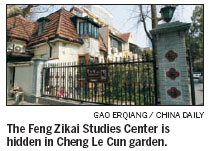
With laundry hanging over the bushes, flowers blooming in the corner and neighbors chatting in the sun, the Chang Le Cun courtyard looks much the same as other communities in downtown Shanghai.
There's nothing to suggest it is the former residence of a renowned man of letters.
Feng Zikai (1898-1975), pioneering cartoonist, essayist and translator, spent the last 21 years of his life in one of its Spanish-style houses.
Born in Tongxiang prefecture, Zhejiang province, Feng was a disciple of Li Shutong, an accomplished scholar who later became a Buddhist master.
In 1921, he traveled to Japan to further his studies. After returning to China, he taught art and music in Shanghai and Chongqing, and became an editor with the Kaiming Publishing House in Shanghai.
Of Feng's numerous creations, his most famous are short essays and cartoons, used as illustrations for primary school textbooks.
The garden served as the German Expats' Country Club when first built in the 1900s. The French later bought it and renamed it "Verdun Garden", and it became a landmark of the French concession.
The garden has original Spanish architectural features, although most of the faded walls are covered in thick vines.
When Feng settled in Shanghai in 1954, he bought a house here and named it Riyuelou, or Tower of the Sun and the Moon, as he could observe the night sky from a small window in the attic of the third floor. It was here that Feng completed the last four volumes of his six-volume anthology of paintings, in memory of his mentor Li Shutong.

The first floor of the house was taken over by the government during the "cultural revolution" (1966-76) and Feng family members gradually moved out after he died in 1975.
The Tower of the Sun and the Moon later housed five families until 2008, when Feng's descendents spent 3.5 million yuan ($533,000) to obtain the use of the second and third floors. The first floor is still occupied by another family.
The renovated second and third floors are now the Feng Zikai Studies Center, displaying the scholar's works and collections.
Despite its narrow space, the peppermint-and-vanilla rooms house a fine collection of paintings, calligraphy works, essays and poems.
Some of the original objects Feng used are now back where they belonged, including a small wooden-framed bed.
On the tables are piles of palm-sized paper, pens and brushes for visitors to leave their messages and sketches. Tens of thousands of visitors from all over the world have left messages complimenting Feng's paintings, essays and translation works.
"I read Feng's essays and enjoyed his comics when I was a little girl, and my excitement at finding his former residence is beyond words," Liu Suyin, 72, says.
Barely a stone's throw away lies South Shaanxi Road, one of the busiest streets in Shanghai. The scenes that Feng once witnessed have now been replaced by boutiques, shopping malls and dashing cars. Only a small sign with the three characters, "Chang Le Cun" written by Feng Zikai at the exit of the garden reminds visitors of the long gone past.
China Daily
(China Daily 03/10/2011 page18)
| 分享按鈕 |