Chinese phoenix - auspicious bird rising from ashes
Fenghuang are mythological birds of East Asia that reign over all other birds. The males are called Feng and the females Huang. In modern times, however, such a distinction of gender is often no longer made and the Feng and Huang are blurred into a single feminine entity so that the bird can be paired with the Chinese dragon, which has male connotations.
 |
Appearance: six celestial bodies
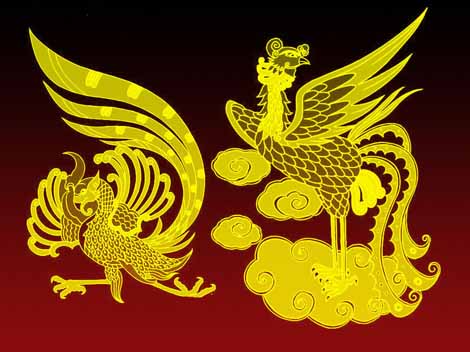
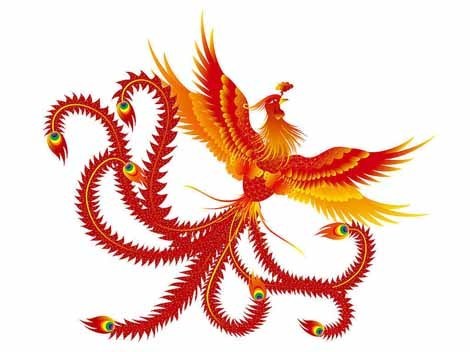
A common depiction was of it attacking snakes with its talons and its wings spread. According to scripture Erya - chapter 17 Shiniao, Fenghuang is said to be made up of the beak of a rooster, the face of a swallow, the forehead of a fowl, the neck of a snake, the breast of a goose, the back of a tortoise, the hindquarters of a stag and the tail of a fish. Today, however, it is often described as a composite of many birds including the head of a golden pheasant, the body of a mandarin duck, the tail of a peacock, the legs of a crane, the mouth of a parrot, and the wings of a swallow.
Its body symbolizes the six celestial bodies. The head is the sky, the eyes are the sun, the back is the moon, the wings are the wind, the feet are the earth, and the tail are the planets. Its feathers contain the five fundamental colors: black, white, red, blue and yellow. It is also sometimes depicted as having three legs.
Origin: good-luck totem
A vase with a phoenix-headed spout, gray sandstone with celadon coating, Song Dynasty, last half of 10th century. Images of an ancient bird have appeared in China for over 4,000 years, the earliest as Shang Dynasty pottery motifs, then appearing decorating bronzes, as well as jade figurines (many of the most beautiful from the Liao Period). Some believe they may have been a good-luck totem, believing that it is a totem of eastern tribes in ancient China. Current theories suggest that it is likely based in part - for example the snake-like neck - on folk memory of the Asian Ostrich which was common in prehistoric China but became extinct several thousand years ago. That this bird was well-known to the early modern humans in Asia, noted for its peculiarity, and hunted for food, is attested by numerous archaeological finds, such as pottery decorated with what appear to be painted ostriches, and bones by early campsites.
|
 |
Fenghuang seems to have no connection with the phoenix of the Western world, which derives from Egyptian mythology. Peculiarly, the Egyptian phoenix may also in part reference a prehistoric bird, the Bennu Heron. Unlike the Fenghuang, which is a chimera not very much like any one extant bird, the Egyptian phoenix is most often considered similar to a heron or eagle.
During the Han Dynasty (2,200 years ago) two phoenixes, one a male (feng, 鳳) and the other a female (huang, 凰) were often shown together facing one other. Later, during the Yuan Dynasty the two terms were merged to become the generally translated "phoenix", but the "King of Birds" came to symbolize the Empress when paired with a dragon as a dragon represented the Emperor. From the period of the Emperor Jiajing (1522-66) on, a pair of phoenixes was differentiated by the tail feathers of the two birds (typically together forming a closed circle pattern--the male identified by five serrated tail feathers (five being an odd, or yang number) and the female by what appears to be one, but is in fact, two (two being an even, or yin number) curling or tendriled tail feathers. It was also in the Ming Dynasty that phoenixes first began to appear with combs, hence comb-less phoenixes are pre-Ming, and phoenixes depicted with combs, Ming or post-Ming.
Also during this period, the feng huang was used as a symbol representing the direction south. This was portrayed through a male and female facing each other. Their feathers were of the five fundamental colors: black, white, red, green, and yellow. These colors are said to represent the Confucian virtues of: loyalty, honesty, decorum, and justice.
Meaning: high virtue and grace
The Fenghuang has very positive connotations. It is a symbol of high virtue and grace. The Fenghuang also symbolizes the union of yin and yang. Shan Hai Jing - chapter 1 Nanshan jing records each part of Fenghuang's body symbolizes a word, the head represents virtue (德,) the wing represents duty (義,) the back represents propriety (禮,) the abdomen says belief (信) and the chest represents mercy (仁.)
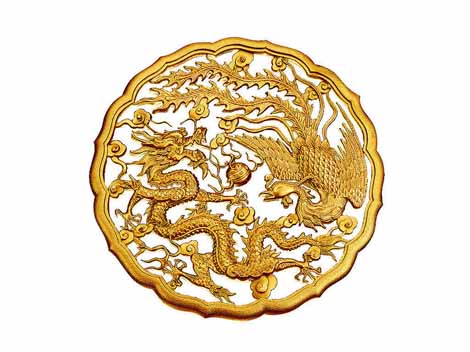 |
In ancient China, they can often be found in the decorations for weddings or royalty, along with dragons. This is because the Chinese considered the dragon and phoenix symbolic of blissful relations between husband and wife, another common yin and yang metaphor.