The Chinese ghost buster
In Chinese folklores, Zhong Kui is a god who exorcises ghosts and evil spirits.
As legend has it, he lived in Zhongnan Mountain in the early Tang Dynasty. He was born with a panther-like head, ring-like eyes, an iron face and curly whiskers. Though very ugly, he was a profoundly learned and talented figure.
As a man of integrity, he always upheld justice and feared no evil or mischievous being. In 712 when Emperor Xuanzong of the Tang Dynasty ascended the throne, Zhong Kui went to Chang'an to take the imperial civil examination. Impressed by Zhong's five poems entitled Holding Banquets in Yingzhou, the chief examiner praised him as a prodigy and enrolled him top of all examinees.
During the palace examination, however, a treacherous minister named Lu Qi judged Zhong Kui by the appearance, and repeatedly spoke ill of him before the emperor. As a result, Zhong Kui failed to claim championship in the exam. Infuriated, he bumped his head against a pillar in the palace and thus killed himself. The entire court was shocked. Then Emperor Dezong issued an imperial edict, conferring upon Zhong Kui the title of Demon Queller who traveled all over the world to kill the evil and expel the wicked. In addition, the official title of Number One Scholar was also buried with him.
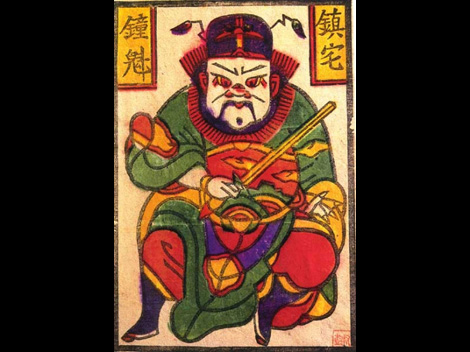 |
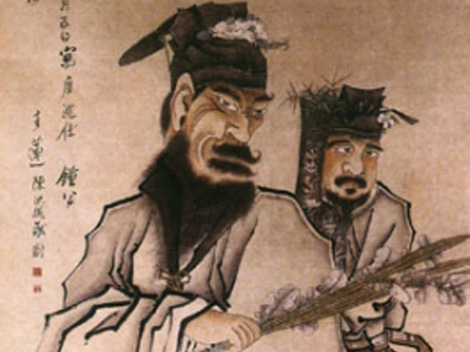
The Painting of Zhong Kui Catching a Ghost, very popular among the folk people, comes from a story recorded in The Book of Unofficial History. Depicting Zhong Kui catching the evil spirit, it is believed to convey the message of avoiding calamity and bringing on good fortune. Therefore, people often buy the painting on festivals and put it up at home.
 |
Previously, people would hang paintings of Zhong Kui on New Year's Eve only. Currently, however, it is on Dragon Boat Festival (5th day of the 5th lunar month) that people paint Zhong Kui, hang the picture in their own houses or give it away as a present. The change originated in 1757, the 22nd year of the Reign of Emperor Qianlong in the Qing Dynasty. A great many people died of plague that year. Helplessly, people resorted to Zhong Kui for help. They bought and put up Zhong's paintings, expecting him to exorcise the evil with his might. In the following years, the practice was continued and gradually developed into a custom.