Secret to being a happy expat understanding differences
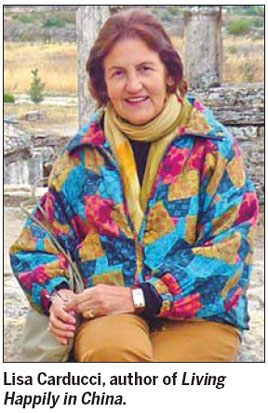
Lisa Carducci, a veteran author who has spent some 20 years in China, has touched upon a core issue for most Western expats in China: How to live happily and meaningfully in the Middle Kingdom?
In her latest book Living Happily in China, published by China Intercontinental Press in October 2010, Carducci draws on her rich experiences to illustrate the cultural differences and similarities whose understanding is vital for a successful stay in the country.
After her first visit in 1985, the Canadian author and China Daily contributor decided to establish herself here.
She recalls that while teaching at a university in Beijing, she had a chair in her room that was uncomfortable. She replaced it with one of the chairs stacked outside the cafeteria, as they looked the same to her.
Not long afterward a university employee knocked on her door and told her, through gestures, that she shouldn't do that. When she asked who made the rule, the man replied: "You gui ding."
Carducci asked for Mr You's office, believing, as most Westerners do, that approaching the official directly would be better than climbing the ladder of hierarchy.
She later learned that "you gui ding" means "there are rules", and the chairs outside the cafeteria were numbered and reserved for celebrations and other special occasions.
Years later, with a perfect mastery of Chinese and a deep understanding of Chinese social protocol, Carducci suggests a much better solution to this kind of trouble: politely explain the situation and ask the Chinese employee to help.
"Then the worker would take this on as a duty and perhaps as an honor to help the foreigner who knows how to behave in a Chinese environment," she says.
Carducci, whose ancestors come from Italy and Canada, has penned poems, essays, travelogues and many other works, in several languages. This helps explain her ability to discern the positive aspects of a new culture quickly.
Even a Chinese reader may marvel at her sharp observations about social etiquette, some of which is no longer followed by the younger generation.
For instance, when and where to sit around a dinner table to show respect to the host and other guests? Should one drink wine alone to quench thirst? And most crucially, how to protect yourself when asked to drink white liquor at banquets. Reading this small book is enjoyable, as Carducci always laughs at her own mistakes with such good humor. For instance, she was once thrown out of a food store for demanding mi fan, cooked rice, while the correct word was da mi, raw rice.
Carducci regards herself as well integrated in her host country. But she points out that integration doesn't mean that one should change into a Chinese person.
"It doesn't mean condemning all that is Western and elevating all that is Chinese. But it is making ourselves feel at ease among the Chinese," she says.
"This requires observation, reflection and adaptation. It means finding our own place in Chinese society and making space for ourselves."
China Daily
(China Daily 02/18/2011 page19)