Highs and lows of a storied past
 |
|
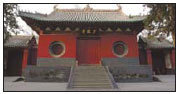
The entrance of Shaolin Temple on Mount Songshan. Wang Zirui / for China Daily |
The temple has been destroyed and rebuilt many times. The reasons were largely political involvement. Legend has it that kungfu rituals evolved from household chores such as sweeping the floor, carrying buckets of water, collecting firewood and Zen practices. By the early Tang Dynasty (AD 618-907), the temple had trained monks into a fiercely combative army. Later, the warrior-monks either sided with the powers-that-be or their opponents, thus attracting retributions left and right.
The monks supported the Ming government (1368-1644), and in 1641 were sacked by the anti-Ming rebel Li Zicheng, which effectively wiped out the temple's fighting force. Its fate during the subsequent Qing Dynasty (1644-1911) was uneven. Kangxi, the second Qing emperor, was a patron of the temple and wrote the calligraphy inscriptions that hang over the Heavenly King Hall and the Buddha Hall to this day. But it suffered destruction for supporting anti-Qing activities, although historians cannot determine when this took place, whether it was 1647, 1674 or 1732.
But royal persecution had an expected fallout: The Shaolin-style martial arts began to spread throughout China via the fugitive monks. There were stories of a southern temple named Shaolin established by these refugees or their disciples. It was supposedly in Fujian province. But historical records are spotty and contrast with the rich folktales from fiction and cinema. Especially vivid are 19th-century secret society folklore and popular literature that helped enshrine the temple and its colorful past in urban myths. But their authenticity cannot be verified.
However, evidence exists that the Shaolin martial arts were exported to Japan in the 18th and 19th centuries. There are many similarities between centuries-old Chinese and Japanese martial arts manuals, and even the name Shorin-ryu sounds similar.
The temple bore two catastrophes in the 20th century: first it was burned down by the warlord Shi Yousan in 1928, destroying 90 percent of the architecture and much of the library, and the "cultural revolution" (1966-76) basically condemned all religious institutions and their personnel.
The temple got a major shot in the arm from the 1982 namesake film, which happened to be Jet Li's screen debut. And now it has again entered its heyday. In 2006, Vladimir Putin became the first foreign leader to visit the temple.
Not only did the Shaolin monks have the license to kick ass, but they were not bound by eating and drinking restrictions. Some say this rare freedom for religious staff was granted by a special "imperial dispensation", but it was not corroborated by any historical documents, such as the Shaolin Stele erected in AD 728. Some say the wining and dining originated with the 1982 film, which features such Falstaffian scenes.
Sometimes it is impossible to tell fact from fiction in Shaolin Temple's storied past.
China Daily