Lantern festival promotes culture in Zigong
|
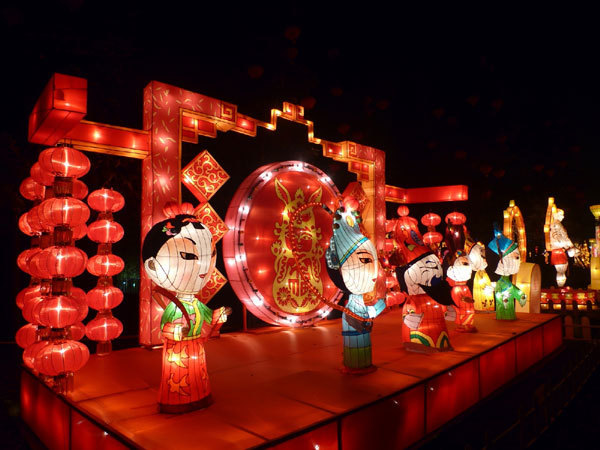 Lanterns featuring figures in Chinese operas./Huang Zhiling |
The slightest mention of the lantern festival would remind people in Sichuan Province of the famed festival in Zigong, a city in the southern part of the southwestern province.
Debuting in the Tang Dynasty (AD 618-907), the Zigong Lantern Festival has been held for more than 1,000 years. Known to every household in Sichuan, it has been held in different parts of the wold.
But at this time of the year, people in Chengdu, capital of Sichuan, do not need travelling for more than two hours to view lanterns in Zigong. Instead, they can see colorful lanterns back at home in the Jinsha Site Museum during the Third Chengdu Jinsha Sun Festival.
Held from January 29 to February 20, the festival is noted mainly for its lantern festival which starts from 6:40 pm to 10 pm each night.
The lantern festival in Jinsha has lanterns featuring figures in local operas and rabbits, for this is the Year of the Rabbit in the lunar Chinese calendar.
But the most conspicous are more than 20 lanterns featuring the sun god. The sun god lanterns lining the path leading to the southern gate, which is the main gate of the Jinsha Site Museum, have been made in line with the Chinese and overseas myth, according to Zhu Zhangyi, deputy curator of the Jinsha Site Museum.
The erecting of lanterns of the sun god has much to do with the sun bird exhibited in the museum, he said.
The circular gold leaf featuring four flying birds surrounding the sun has been chosen as the symbol of China Cultural Heritage by the State Administration of Cultural Heritage.
The emblem's exquisite craftwork and its representation of ancient Chinese people's worship for the sun and the Chinese nation's enterprising spirit account for the decision, according to the administration.
The gold-leaf sunbird, believed to be about 3,000 years old, was excavated from the Jinsha Ruins in the western suburbs of Chengdu. The Jinsha Site Museum has been built on the ruins.
On February 8, 2001, builders were working at an apartment construction site in Jinsha village. Suddenly they found ivory and jade were amidst the piles of mud.
Since then, archaeologists have excavated more than 5,000 precious relics including gold, jade, bronze and stone wares as well as one ton of whole elephant tusks and tens of thousands of pottery and ceramic pieces.
Many relics unearthed from the Jinsha Ruins including the sun-bird gold leaf are on display in the Jinsha Site Museum.
In addition to lanterns, visitors to the museum are drawn by its maze where one can experience the pleasant surprise of solving riddles about words and idioms.