All the better to see you with
|
Elderly people should be cautious about age-related macular degeneration, the leading cause of blindness. Chen Shichuan / Asia News Photo |
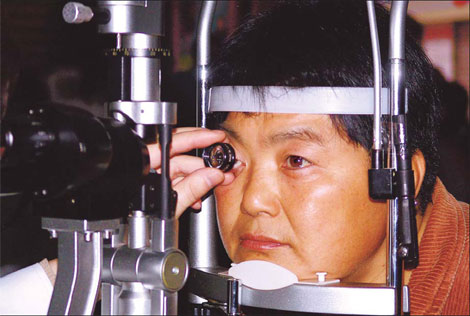
A new study says that a diet rich in vitamins, beta-carotene and zinc can prevent age-related deterioration of the eyes.
A large fraction of elderly people have age-related degenerative changes in their eyes that put them on a path to blindness - but could be preventable - a new study finds. Eye exams given to more than 5,000 elderly Icelanders found that more than one in 10 people in their 60s and nearly one in four in their late 70s have an early form of age-related macular degeneration (AMD), the leading cause of blindness.
The risk of later-onset forms of the condition also increased with age, the authors report in the journal Ophthalmology. People aged 85 and older appeared to be 10 times more likely to have late AMD than people aged 70 to 74.
Recent evidence suggests that there may be a way to prevent the progression of some of these lesions, says study author Dr Fridbert Jonasson of Landspitali University Hospital and the University of Iceland.
There is no cure for AMD, but a United States government clinical trial has found that a specific high-dose mix of antioxidants - vitamins C and E, beta-carotene and zinc - can slow the progression of AMD that is in the intermediate stages, and doctors now commonly prescribe it for such patients.
Another study published earlier in 2010 found that older adults who eat fatty fish at least once a week may have a lower risk of serious vision loss from AMD.
"Catching AMD early means that we can start this treatment early, so hopefully reduce the risk of late AMD," Jonasson says.
AMD is caused by abnormal blood vessel growth behind the retina or a breakdown of light-sensitive cells within the retina itself, both of which can cause serious vision impairment.
Despite the frequency of AMD, it has not been clear how often it occurs in the "oldest old", Jonasson says. To investigate, Jonasson and colleagues captured detailed images of the eye interior of 5,272 people aged 66 and older living in the Reykjavik area.
They found that 11 percent of people in their late 60s had an early form of AMD. As they aged, the rate of early AMD increased, to 36 percent of people 85 and older.
Two forms of late AMD (geographic atrophy and exudative AMD) also increased with age, from affecting one percent or less of people ages 75 and younger, to between 8 and 11 percent of those 85 and older.
This dramatic increase was somewhat unexpected, Jonasson acknowledges. "We know that this condition is age-related; however, it was a surprise to me to find those in the oldest age-group had a 10-fold higher prevalence of late AMD than those 70 to 74 years old."
The rates of late AMD in this Icelandic population also exceed most of those found among previously studied populations, and may have something to do with pigment, Jonasson explains.
Icelanders tend to have less pigment in their skin than other populations, and therefore less pigment in their hair, eye color and retina.
"We do not know if this makes the retinal pigment (tissue) more vulnerable to AMD; however, several studies have shown, for instance, blacks are less likely to develop late AMD than are whites."
Dr Stuart Richer of Department of Veterans Affairs Medical Center and Rosalind Franklin University of Medicine & Science, who reviewed the findings, says the article confirms what many people already know: "AMD disease gets worse with age, impacting on crucial activities of daily living such as reading standard-size print and safely driving an automobile at night."
Sadly, the report likely captures only the "tip of the iceberg", since newer technology, available since the study was conducted, allows doctors to look deeper and observe pathology that was invisible using earlier techniques.
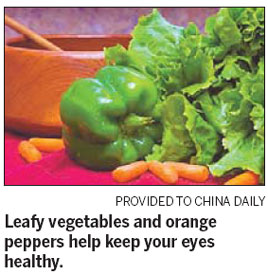
And there may be one more reason why Icelanders may be more prone to AMD, Richer notes - a relative lack of dark, leafy vegetables in their diets.
Research suggests that people who consume more xanthophylls - found in green leafy vegetables or orange peppers, for instance - tend to have healthier eyes.
He adds he was particularly concerned to see the risk of late AMD skyrocket among people in their 80s.
"The population is aging and driving safety is likely to be impacted," he says.
Reuters
(China Daily 01/26/2011 page19)