Travel
Anhui’s legacy
By Lu Hong (China Daily)
Updated: 2011-01-23 08:52
 |
Large Medium Small |
|
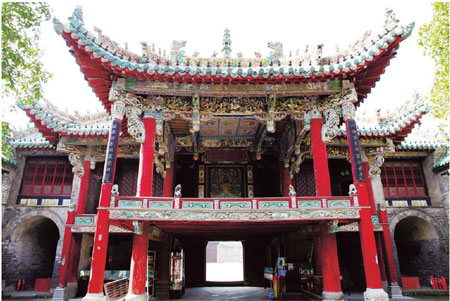
Huaxi Lou (Opera Theater) is famous for its exquisite carving and colorful murals. Today, there are performances held regularly in the annex wing of the theater. Liu Qinli / for China Daily |
|
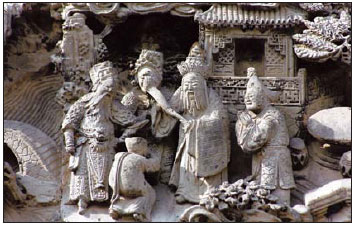
Brick relief carvings at Huaxi Lou. Zhang Yanlin / for China Daily |
|
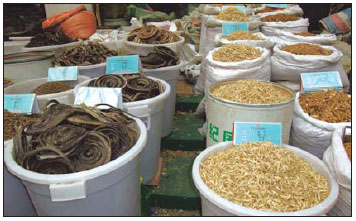
Bozhou is also known as the "Chinese medicine capital". Lu Hong / China Daily |
A major character in the era of the Three Kingdoms was the warlord Cao Cao. Almost two thousand years later, he is the central figure who may bring more tourists to Bozhou. Lu Hong walks the path of history.
Bozhou, in Anhui province, is a tranquil place for tourists to get a feel of China's history. The city, often overshadowed by Anhui's better known scenic Huangshan Mountain and Mount Jiuhua, is a little off the beaten tourist track, but here you get the chance to slow down, stroll around, talk to the locals and soak in a sense of the past that still permeates.
This is the hometown of heroes, including one straight from the pages of ancient history - the warlord Cao Cao from the Three Kingdoms period (AD 220-280), who was born and raised here until he was 14.
In his later years, he would return and recruit his army from his hometown.
Cao Cao is now once again in the limelight. Last year a large graveyard was found in Anyang in Henan province, and there were claims that this was Cao Cao's tomb, quickly refuted by archaeologists.
Many experts in Bozhou believe that his tomb is located in Guanyin Hill at the city's suburbs, near the graves of his family members, and the local government plans to excavate the tomb. If the great warlord is indeed buried here, it would boost archaeological interest and the tourism industry.
His tomb will only add to the existing testimony of his military strategies already found here. An Underground Troop Tunnel is in the old city area, extending from four directions from Dayushou.
More than 10,000 meters of tunnels have already been found, and the network has been described as the "Underground Great Wall".
The structures are pretty uniform, generally dug two to three meters below ground, and built from brick, clay and wood, with intricate paths that directed traffic one-way, two-way or on two levels.
The historical annals record that Cao Cao first built the tunnels when he was leading a military uprising. He was regrouping after he lost a battle.
He had his troops dig a tunnel, sent soldiers outside the city through the tunnel at night and had them return through the city gate at daylight. This gave the enemy at siege the false impression that reinforcements were arriving every day to boost the numbers - and, intimidated, the rival forces retreated.
Another must-go scenic spot in Bozhou is the Huaxi Lou (Opera Theater). Built in 1676, it's famous for its exquisite carving and colorful murals. The main gate is a three-tiered memorial brick arch with three-dimensional carvings.
On a brick surface that is less than 5 centimeters thick, a frieze of 115 characters, 33 birds, 67 beasts and innumerable flowers and plants are carved, telling classic stories from China's religions, history, politics and customs.
The carvings on the stage, too, has entranced visitors with their narration of the 18 operas from the Three Kingdoms period, involving a cast of hundreds.
More than 300 years after they were first made, the characters are still bright and colorful. The stage, though, has been corroded by age, and it is no longer possible to step up for a closer look.
Instead, there are opera performances held regularly in the annex wing of the theater featuring many first-class artists.
The performance, a poetry recitation, draws from the repertoire of works that Cao Cao created in an autobiographical narration of his life and loves.
Our guide also told us that Bozhou wants to apply for the title of "Land of Longevity" because there is one centenarian for every 10,000 residents here. Here, many shops with signboards promote medicated diets, medicated wines, herbal tea and medicinal baths.
Bozhou is also known as the "Chinese medicinal capital". The famous herbalist Hua Tuo, created the first "medicine garden" in Bozhou, and the skill of herb-raising has since been passed down from generation to generation.
China's largest traditional Chinese medicine trading center is in Bozhou, and residents proudly claim that there is no Chinese medicinal herb you cannot find here.
(China Daily 01/23/2011 page16)