Lu Xun Award stirs debate about criteria
By Mei Jia (China Daily)
Updated: 2010-10-26 09:15
 |
Large Medium Small |
This year's prestigious Lu Xun Literature Award, the fifth since being initiated in 1986, has triggered much debate about the quality of literary creations and the criteria used to select the winners.
Che Yangao, a member of the Wuhan municipal committee and secretary of the city's discipline and inspection committee, caused a stir online when he won the award in the poetry category.
Netizens questioned not just the literary quality of Che's poems, especially the ones dedicated to some mainland actresses, but also the integrity of the jury.
Che's poems have since been called "lamb (yanggao) style", in an obvious reference to Che's name while also drawing a parallel between the naive animal and what are dubbed his "nonsensical, conversation-like lyrics".
The Chinese Writers' Association, which gave out the award, insisted Che deserved the award. "Che wins for Longing for Warmth. The collection meets the standards the award demands," it said in a statement.
The actresses-themed poems are not part of the winning collection.
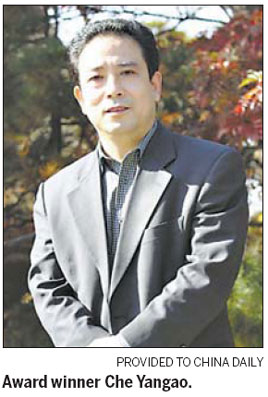
Che has studiously avoided being drawn into a discussion about the quality of the poems, calling them literary experiments.
"All my poems are the natural expression of my emotions," he told The Beijing News.
Meanwhile Liu Xuelan, of the Chinese Academy of Social Sciences and the award's judge for translations, explained the unexpected absence of a winning work in this category.
"It highlights a long-existing fact: The quality of translations is going down," Liu said, attributing this to the profit-driven rush to complete translations on the part of publishers and translators, as well as insufficient rewards for translators, both financially and academically.
"However, it also shows that the Lu Xun Award will not compromise on quality," she added.
She suggested setting up a government-funded Translation Foundation to facilitate quality translations. She said she hoped readers' recommendations would play a bigger role in the nominations.
Despite these issues, critics pointed out the 2010 list has quite a few works worthy of serious consideration.
Su Tong, who shot to international recognition when he won the Man Asian Literary Prize in 2009, was given an award for the short story Cigu, inspired by a rural girl.
Tsering Norbu, a Tibetan writer who debuted in 1992 with a short story about boatmen, won an award for Fang Sheng Yang (The Sheep Freed), putting him on a par with another Tibetan writer, A Lai.
Two out of the five winning reports were about earthquakes, reflecting Chinese writers' belief in the triumph of the human spirit.
"The award gives due recognition to the people the works focus on," said Wang Shiyue, whose National Order won in the novelettes category.
Wang, a self-taught writer who was formerly a migrant worker, has won acclaim for his intimate accounts of grassroots people that draw from his own experiences.
He Renyong, a freelance critic who maintains an influential blog, said he was encouraged by the debate the Lu Xun Award has stirred because "it shows that people still care about literature at a time when money seems to be all-important".
The awards ceremony will be held in November in Shaoxing, Lu Xun's hometown, in Zhejiang province.