TCM takes root in the land of samba
Updated: 2010-10-20 09:13
By Liu Xiangrui (China Daily)
|
|||||||||


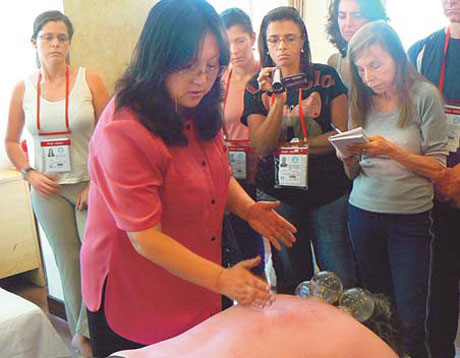
Traditional Chinese Medicine (TCM), especially acupuncture, is spreading fast in Brazil, winning praise from even Brazilian President Luiz Inacio Lula da Silva.
Lula once told a reporter with the newspaper O Estado de Sao Paulo that he had no doubts about the effectiveness of TCM after his Chinese doctor "cured his arthritis of the shoulder with some tiny needles". He even takes along his Chinese doctor on his overseas visits.
In September, a Brazilian delegation of physicians, the 10th since 2006, came to the country as part of a training program hosted by the Specialty Committee of Cosmetology under the Beijing-based World Federation of Chinese Medicine Societies.
The two-week program highlighted TCM prescriptions for common skin problems such as freckles and acne.
"We try to resolve external problems by curing the body internally," says Chen Juan, vice-secretary general of the committee. "Some skin problems can be tackled through herbal treatments while others may require the use of traditional techniques such as acupuncture, Chinese massage, cupping, and skin scraping."
Besides, the committee also promoted the use of TCM for menopause problems, insomnia, anxiety neurosis, senile dementia, joint pain, rheumatism and diabetes, where it has proven to be effective.
Trainees learned acupuncture and other techniques with experienced TCM experts such as Pu Zhilan, a distinguished expert with Tong Ren Tang - one of the country's biggest TCM pharmacies - Zhang Jian, Wang Hong and Tang Lixin.
To further promote TCM in Brazil, the committee is planning a health-and-beauty-themed forum there in 2011.
"Brazil is one of the few non-Asian countries that have legitimate acupuncture and other TCM therapists," says Jiang Zaizeng, head of the committee. "But its large population means there is still a huge market potential for TCM."
Currently Brazil has an estimated 10,000 physicians specializing in acupuncture and Chinese massage, with 3,000 in Sao Paulo alone. About 600,000 people seek TCM treatment in Sao Paulo every year, according to the World Federation of Chinese Medicine Societies.
"Brazilians too used to treat common ailments with herbs, which may explain why they accept TCM well," says Paul Vieira, president of the Brazil-Oriental Trade Company of Natural Medicines. He has been importing herbs from China for 20 years and has led several delegations for TCM training.
One of the trainees, Elder Narciso Feltrim, was initially a surgeon and later decided to learn acupuncture and TCM theories in the Acupunctural Medical College in Brazil.
"It's new and promising," says the physician with seven years of experience in acupuncture.
The Federal Medical Council, which regulates medicine in Brazil, recognized acupuncture as a medical specialty in 1995; and it was officially deployed in the Unified Health System of Brazil as naturopathy in 2006, together with herbal therapy, food therapy and warm baths.
"While official recognition and positive feedback have eliminated some doubts, many people in Brazil still see TCM as something magic or supernatural and divorced from modern science," Vieira says.
Even professionals who learn acupuncture have difficulties understanding concepts like yin and yang, and the five elements theory, and in applying them in the diagnosis.
"The cultural and philosophical differences between TCM and Western medicines are major obstacles in the way of TCM going international," Jiang, committee head, admits. "That's the reason we should promote TCM alongside Chinese culture."
While TCM is widely accepted in Asian countries, in most Western countries herbal medicines can only be supplied as health products; TCM practitioners are limited to clinics and not licensed as doctors. Only recently, Australia has passed an act to license TCM doctors nationwide in 2012, which means TCM will become part of its healthcare system.