Comments
  Print
Print  Mail
Mail  Large Medium Small
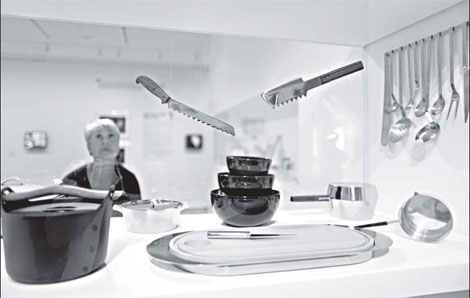
The modern kitchen began to take shape sometime around 1900. It has been a leading indicator of the state of design ever since. It has also been a battlefield of conflicting belief systems. As the use of servants declined, housewives became at once early adopters of new products meant to free them from drudgery and targets of corporate advertising that relentlessly defined them as household fixtures themselves.
Kitchens have long been heavily symbolic sites. This is elaborately demonstrated by "Counter Space: Design and the Modern Kitchen" at the Museum of Modern Art through March 14.
Using a tantalizing sprawl of some 300 design objects, artifacts and artworks, "Counter Space" covers an amazing amount of social and aesthetic history. The kitchen's design evolution meshed with the new availability of gas and electricity; with the rise of cities, the middle class and health consciousness; with the growing independence of women; and of course with the emergence of modern design itself, whose self-conscious brief was to improve everyday life.
Two world wars fed innovation by promoting efficiency, creating food and housing shortages and luring women into the work force. As cities grew, the kitchen's need for fresh foodstuffs, heating and cooling energy, and waste disposal connected it to urban networks that were themselves still taking shape.
MoMA's determination to encompass all that is emblematic of modern life is breathtaking. The objects range chronologically from the brown paper bag that Charles Stillwell designed in 1883 to Philippe Starck's overly sculptural Juicy Salif Lemon Squeezer of 1988 (a countertop Louise Bourgeois spider)
and Smart Design's user-friendly Good Grips peeler of 1989.
The show's stupendous centerpiece is one of the last surviving examples of a Frankfurt Kitchen designed in 1926-27 by Margarete Schutte-Lihotzky, Austria's first female architect. Mass produced to meet housing shortages in Frankfurt caused by World War I, it remains a model of clarity and purpose.
It is probably alone in being the subject of a recent music video tribute by the Austrian musician Robert Rotifer, also in the show.
"Counter Space" proceeds in three sections. "The New Kitchen" centers on design up through World War II, when the kitchen was conceived of as a kind of no-nonsense laboratory. Form follows function here.
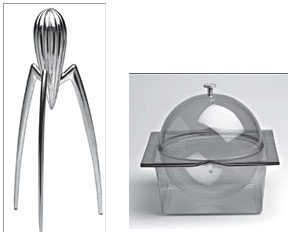 |
| Philippe Starck's Juicy Salif Lemon Squeezer from 1998 resembles a Louise Bourgeois spider sculpture. Right, Kenneth Brozen's aluminum and acrylic serving bowl made plastic elegant. Museum of Modern Art |
Clever forms and pretty colors often superseded function. But this was also the heyday of Braun's svelte appliances that made plastic seem as refined as porcelain, and signaled a Germany design resurgence.
The final section, "Kitchen Sink Dramas," centers on Pop Art - Andy Warhol's Brillo boxes, paintings by James Rosenquist and Tom Wesselmann - and continues nearly to the present. The progression provides a sharpened sense of the organic relationship between art and its social context.
An especially vivid example of this relationship is provided by the short films and television commercials, supply visual evidence of the stereotypes that artists began to dismantle in the 1970s as the women's movement got under way.
The connection is of course standard art history, but to see it made with real-life art and artifacts against the rich backdrop of this exhibition is something else. Art may not be the best revenge, but it certainly helps.
The New York Times


Copyright 1995 - . All rights reserved. The content (including but not limited to text, photo, multimedia information, etc) published in this site belongs to China Daily Information Co (CDIC). Without written authorization from CDIC, such content shall not be republished or used in any form. Note: Browsers with 1024*768 or higher resolution are suggested for this site.
License for publishing multimedia online 0108263 Registration Number: 20100000002731