Comments
  Print
Print  Mail
Mail  Large Medium Small
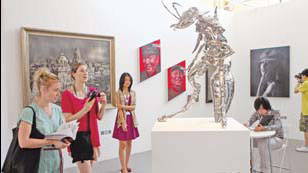
The 14th Shanghai Art Fair, held from Sept 8 to 12, at Shanghaimart, announced the total trade volume of this year's fair rose to almost 70 million yuan ($10.4 million), 40 percent higher than last year.
"China's art market is picking up slowly after the bubble burst at the end of 2008," said Mauro Malfatti, director of the International Division of BolognaFiere, organizer of ShContemporary, held from Sept 9 to 12 at Shanghai Exhibition Center.
However, although ShContemporary has established a reputation as one of the best contemporary art fairs in Asia, insiders say that heavy taxation has hindered its development.
Imported artworks are in the same category as luxury goods in China and attract a 33 percent tariff if sold at art fairs in the Chinese mainland. Art fairs in Hong Kong and Singapore, on the other hand, have "zero tariff" policies.
"It has been a major problem, and we have filed reports to the relevant government sectors," said Gu Zhihua, executive secretary of the Shanghai Art Fair Organizing Committee. "But this issue involves very senior departments of the government and changes can't be made overnight."
Many industry insiders make their deals elsewhere in order to avoid paying the tariff.
"You can find an artwork you like at ShContemporary, then make the deal later in Hong Kong and bring the piece into the mainland," said a gallery owner who asked not to be named. "It's common practice - that's why a fair like ShContemporary doesn't disclose its trade volume."
When the buyer brings the piece to China, he can declare a much lower price to the Chinese Customs, which is incapable of accurate evaluation of the true price of an artwork, especially a contemporary piece, Malfatti explained.
One gallery owner said that you can even call the artwork a "personal belonging" and avoid paying the tariff altogether.
"Unless this obstacle is removed, there can't be any common art market communication," said Dr Yu Jinglu, director of the Shanghai Grand Theater Gallery.
Another problem is shipment. One gallery owner who asked to remain anonymous, said that artworks are often damaged at Chinese Customs, when shipped in or out of China and that bureaucratic hassles often delay artworks at customs while the necessary paperwork is sorted out.
"Of course you can hire professional art shipping companies - who have the right connections for the job, but the cost will be five to eight times higher than shipping artworks as ordinary goods."
Despite these difficulties, China's collectors are still showing great enthusiasm for investing in art.
"Now the stock market is not doing well, people have realized that buying art can be a good investment," Yu said.
The contemporary Chinese art scene was discovered by the international art world around 2000. Prices soared rapidly for Chinese art, and a bubble arose in the market, Malfatti said. The global economic recession burst the bubble and the market experienced a 30-45 percent drop in prices.
Now collectors are becoming more informed.
"They are learning to pay attention to the quality of the artworks, and buying something they truly like, instead of something they believe will increase in value very soon," Malfatti said.
Both the Shanghai Art Fair and ShContemporary have organized educational events for potential investors, believing that their maturity can boost the healthy development of China's art market.
Shanghai Art Fair invited experts to evaluate private collections of jade, ceramic, antiques and artworks, and special classes were given to VIP clients of the Industrial and Commercial Bank of China about art appreciation.
ShContemporary's Asia Pacific Collectors Development Program, which takes collectors to international art fairs and museums and teaches them art history and appreciation, held contemporary art forums at this year's event.
Uli Sigg from Switzerland, one of the most important private collectors of contemporary Chinese art who has been buying contemporary Chinese art "from day one of its appearance", said that he would continue to buy contemporary art, but he would only consider buying artworks from well-established artists such as Zhang Xiaogang and Fang Lijun "if they do something different, something new".
?


Copyright 1995 - . All rights reserved. The content (including but not limited to text, photo, multimedia information, etc) published in this site belongs to China Daily Information Co (CDIC). Without written authorization from CDIC, such content shall not be republished or used in any form. Note: Browsers with 1024*768 or higher resolution are suggested for this site.
License for publishing multimedia online 0108263 Registration Number: 20100000002731