Comments
  Print
Print  Mail
Mail  Large Medium Small
An exhibition of ancient books, documents and seals is set to open on Friday at Xinjiang Uygur Autonomous Region Museum in Urumqi.
Organized by the China National Preservation and Conservation Center for Ancient Books in the National Library of China, it is the first comprehensive exhibition of this kind since 1949 and will close on Sept 15.
It includes 106 items that date back to 4,000 years ago and up to the Qing Dynasty (1644-1911). Regional museums, libraries and academic institutes have contributed to the exhibition.
More than half of the exhibits are unique and 25 of them are listed in the Album of National Rare Ancient Books.
Accounts of the Western Regions of the Great Tang Dynasty, written by Tang Dynasty (AD 618-907) Buddhist master Xuanzang in AD 646, after his pilgrimage to India, provides information on the politics, military, geography, religion, culture, language and social status of kingdoms in central Asia and India.
A transcript of Xuanzang's work was made soon after the original was completed. Researchers say it was the earliest copy of the work and was offered to Turpan, an important trade center on the Silk Road.
Part of the area known as "Xiyu" (western regions), Xinjiang had many important trading posts along the Silk Road and remained a center for the confluence of various cultures over many centuries.
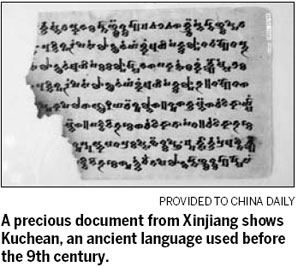
The exhibits are in 24 languages, some of which were used by ancient ethnic groups and have never been shown to the public before. The Kharosthi script, for example, was used before the 3rd century; while Kuchean, a branch of the Tocharian language, was used before the 9th century.
The variety of ancient scripts is a challenge for contemporary researchers, says Chen Hongyan, director of the office of China National Preservation and Conservation Center for Ancient Books.
"Ancient books in Xinjiang were often written on both sides of mulberry paper. Few researchers in the region knew how to repair such books," Chen says.
Since 2007, the center has invited researchers from Xinjiang to attend its annual trainings on preserving ancient documents. Two such workshops were held in Xinjiang last year.
Systematic preservation of historical documents in Xinjiang began in the 1950s. Over the past 30 years, the Annotated Bibliography of Literature on Xinjiang Ethnic Groups and some ancient books found in the region have been published or reprinted.
This year, conservation work in Xinjiang became part of the national Ancient Books Conservation Project, which was launched in 2007.
Li Jianjun, vice-director of the Culture Department in Xinjiang, says the government has invested 1.47 million yuan ($216,000) in preserving historical documents over the past three years. He says the lack of qualified experts and funds, however, poses major difficulties.
The priceless exhibits will be sent to the National Museum of China in Beijing later this year. Albums of the exhibits will also be released in the near future.
?


Copyright 1995 - . All rights reserved. The content (including but not limited to text, photo, multimedia information, etc) published in this site belongs to China Daily Information Co (CDIC). Without written authorization from CDIC, such content shall not be republished or used in any form. Note: Browsers with 1024*768 or higher resolution are suggested for this site.
License for publishing multimedia online 0108263 Registration Number: 20100000002731