Thought process
By Wang Ru (China Daily)
Updated: 2010-08-16 09:20
 |
Large Medium Small |
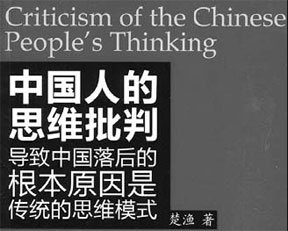
While British sinologist Joseph Needham attributed significant weight to the impact of Confucianism and Taoism on the pace of Chinese scientific discovery, Chu Yu believes the impact of Confucianism is not the major stimulus.
In his Criticism of the Chinese People's Thinking, published by People's Press, Chu argues that Confucianism also profoundly influenced Japan and South Korea, and both continued to make progress in science and technology.
Instead, he suggests that the Chinese way of thinking - vague, random and lacking logic, which he says is still dominant today - is the true culprit.
Chu says that the Pre-Qin Period (before 221 BC) represented the essence of Chinese culture. Since the Song Dynasty (960-1279), extreme centralization has shaped the way of thinking of Chinese people.
After Ming Dynasty (1368-1644), the spirit of Chinese culture decayed, including the essence of Confucianism. The consequence was underdevelopment and concessions to the Western powers.
In the book, Chu compares the history of Western civilizations, especially the Enlightenment and Industrial Revolution, to the underdevelopment in China's modern history.
Some scholars have argued that Chu's book, with its radical views and mistakes on understanding Chinese culture, should be discounted as an academic book on philosophy. Others say that political and economic reforms, instead of a change in the Chinese way of thinking, are the ways to energize the country.
Most scholars, however, agree that Chu has picked a good topic, which deserves society's attention.
"Despite its problems, it is a valuable book that questions the nation's way of thinking," says Li Shaobing, a professor from School of History of Beijing Normal University.
Liu Zhiqin, a researcher on modern Chinese history from the Chinese Academy of Social Sciences, agrees and gives the example of Zhang Taiyan, a scholar of the late Qing Dynasty (1644-1911).
Over a century ago, Zhang criticized Chinese academic circles for their lack of ability, analysis and logical thinking. The problems still exist today, Liu says.
Chen Qineng, a researcher on Chinese and world history, admits that Chu's book is inspiring, but he also points out that the way of thinking is a profound and comprehensive philosophical topic, and different cultures have their own merits and shortcomings.
"Science itself is a double-edged sword," Chen says.
Adding that in the face of the growing environmental crisis and disasters caused by modernization and industrialization, Western sociologists are reevaluating their way of development and thinking. Chinese should do likewise and reflect upon themselves.