World cultural heritages on stamps
The Forbidden City
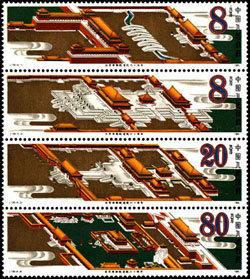
The Forbidden City was the Chinese imperial palace from the Ming Dynasty to the end of the Qing Dynasty. It is located in the middle of Beijing, China, and now houses the Palace Museum. For almost five hundred years, it served as the home of emperors and their households, as well as the ceremonial and political centre of Chinese government.
Built in 1406 to 1420, the complex consists of 980 surviving buildings with 8,707 bays of rooms and covers 720,000 m2. The palace complex exemplifies traditional Chinese palatial architecture, and has influenced cultural and architectural developments in East Asia and elsewhere. The Forbidden City was declared a World Heritage Site in 1987, and is listed by UNESCO as the largest collection of preserved ancient wooden structures in the world.
Since 1925, the Forbidden City has been under the charge of the Palace Museum, whose extensive collection of artwork and artifacts were built upon the imperial collections of the Ming and Qing dynasties. Part of the museum’s former collection is now located in the National Palace Museum in Taipei. Both museums descend from the same institution, but were split after the Chinese Civil War.
|
 |
The site of the Forbidden City was situated on the Imperial City during the Mongol Yuan Dynasty. Upon the establishment of the Ming Dynasty, the Hongwu Emperor moved the capital from Beijing in the north to Nanjing in the south, and ordered that the Yuan palaces be burnt down. When his son Zhu Di became the Yongle Emperor, he moved the capital back to Beijing, and construction began in 1406 of what would become the Forbidden City.
The Forbidden City is the world’s largest surviving palace complex and covers 72 ha. It is a rectangle 961 meters from north to south and 753 meters from east to west. The Forbidden City was designed to be the centre of the ancient, walled city of Beijing. It is enclosed in a larger, walled area called the Imperial City. The Imperial City is, in turn, enclosed by the Inner City; to its south lie the Outer City.
The Forbidden City remains important in the civic scheme of Beijing. The central north-south axis remains the central axis of Beijing. This axis extends to the south through Tiananmen gate to Tiananmen Square, the ceremonial centre of the People's Republic of China. To the north, it extends through the Bell and Drum Towers to Yongdingmen. This axis is not exactly aligned north-south, but is tilted by slightly more than two degrees. Researchers now believe that the axis was designed in the Yuan Dynasty to be aligned with Xanadu, the other capital of their empire
The Peking man Site in Zhoukoudian
The Peking Man Site in Zhoukoudian was listed on world cultural heritage by UNESCO in December 1987.
|
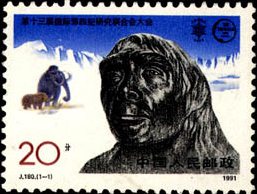 |
On the Dragon Bone Hill in Zhoukoudian, about 50 kilometers southwest of Beijing, is the Site of Peking Man where fossils of the Chinese ape-man and their caves were found. About 450 million years ago, the area around Zhoukoudian used to be an ocean. Later, the water receded as a result of diastrophism, finally forming Dragon Bone Hill. The first complete skull of the Peking man was discovered in December, 1929 by a Chinese paleo-anthropologist. In the following years, large-scale excavations were done. Fossils of men and vertebrates were found including skulls, facial bones, lower jawbones and teeth belonging to over 40 individuals of various ages and sexes.
The research on the data proves that the Peking man lived 690,000 million years ago and they belong to species Homo erectus. They lived in caves and hunted and they could use and make simple stone-made tools. In addition, they have the knowledge on how to make a fire to keep them warm and heat their foods. The Peking man during that time belongs to the Paleolithic Period. Until today, Peking man holds as ever a realistic and scientific value. The Peking Man Site represents the most comprehensively and systematically studied site of Homo erectus. The Peking Man Site also provides the more precise scientific data for the study of the evolution, behavior, and paleo-environment of Homo erectus than contemporary African and European sites.