Founder-worshipping culture in Chinese society
Among Chinese folk cultures, a most interesting part belongs to the worship of business pioneers, who has been regarded as the greatest master or the guardian of prosperity in the market. As an old saying goes, a business cannot survive without the presence of its founder. Some of the founders are reputed ones who pioneered the business while some of them were artificially presented as the founders by the late generations. One founder may be shared by many different businesses, and on the other hand, certain business sectors may boast more than three founders.
The following is a basis of the founder-worshipping culture in Chinese society.
Huang-di (also known as the Yellow Emperor) for tailoring
Huang-di is a legendary Chinese sovereign and cultural hero who is considered in Chinese mythology to be the ancestor of the Han Chinese people. It is recorded in Historical Records, an ancient historical book, by the historian Sima Qian that Yellow Emperor once taught his people to make clothes by stitching leaves with needles made of bones. As a result, he has been regarded as the business pioneer in tailoring.
| ?
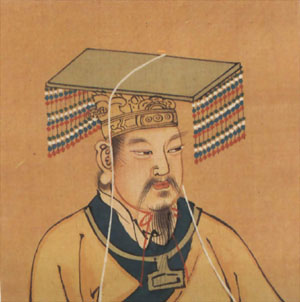 Huang-di |
Interestingly enough, Huang-di is accredited with many inventions just because of his majesty and cultural identity within the history of China.
Du Kang for wine
Du Kang is a semi-legendary inventor of liquor in Chinese history. Since wine is widely known as an important part of the ancient Chinese rites and the court culture, its invention is not attributable to a single person. Du Kang is sometimes reported to be a minister to the Yellow Emperor. He is more of a cultural symbol than a historical personality.
Lu ban for carpentry
Lu ban is a brilliant inventor and good with woods. He is well noted for his achievements. There were various inventions which were attributed to him, such as burial lifting implements, wooden horse carriage and coachman and some other woodworking that can be seen from various texts which thereafter led Lu Ban to be acknowledged as the master craftsman.
Confucius for education
It is widely accepted that Confucius is the most excellent teacher in Chinese ancient history, with more than 3000 students to his credit and 70 of them formed the backbone of the ancient Chinese states.
In the Analects, Confucius presents himself as a "transmitter who invented nothing". He puts the greatest emphasis on the importance of study. In this respect, he is seen by Chinese people as the Greatest Master.
Bian Que and Hua Tuo for traditional Chinese medicine
Bian Que was, according to legend, the earliest known Chinese physician. He excelled in pulse taking and acupuncture therapy. Tales state that he was a doctor of many disciplines, conforming to the local needs wherever he went. For example, in one city he was a children's doctor, and in another, a female physician. Bian Que advocated the four-step diagnoses: Looking (at their tongues and their outside appearances), Listening (to their voice and breathing patterns), Inquiring (about their symptoms) and Taking (their pulse).
| ?
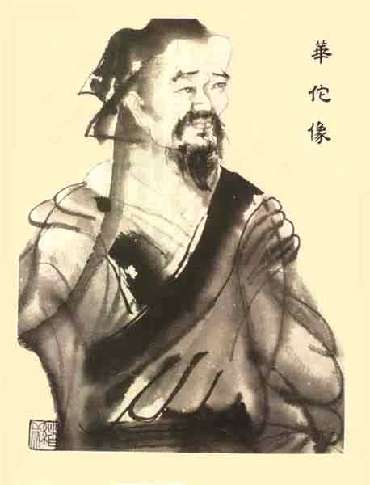 Hua Tuo |
Another founder is said to be Hua Tuo. He was a renowned Chinese physician during the Eastern Han Dynasty and Three Kingdoms Period. The Records of Three Kingdoms and Book of Later Han recorded Hua as the first person in China to use anesthesia during surgery. He used a general anesthetic combining wine with a herbal concoction called mafeisan (literal translation: "cannabis boil powder"). Besides being respected for expertise in surgery and anesthesia, Hua Tuo was famous for his abilities in acupuncture, moxibustion, herbal medicine, and medical Daoyin exercises. He developed the Wuqinxi, also known as Exercise of the Five Animals, from studying movements of the tiger, deer, bear, monkey, and crane.
Further down the road is a longer list of founders for every business. Apparently, some of those founders are fictional and people take them as a founder in order to add something unique or mysterious to their business. This branch of Chinese folk culture, without question, will live on as companies go through its ups and downs in the business cycle.