Qiang folks push past forward
That was Yang Huawu. On a pleasant evening in Mianyang, Sichuan Province, he was sitting in an area where two years ago an earthquake killed about 70,000 people. It may be hard to see any evidence of the havoc wreaked by the earthquake in the city. But it is etched in Yang's memory, embedded in his heart.
|
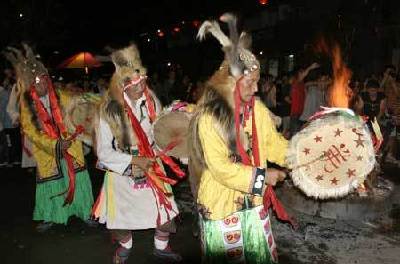 Qiang people make a devotional offering to their god at a Qiang New Year ceremony. |
He has typical Qiang ethnic features with curly hair, big eyes and a strong, firm face with a permanent tan. "I was lucky to survive the earthquake. I saw my friends die in front of me, and that was terrible," said Yang, who is director of the Qiang Ethnic Folk Culture Performance Troupe.
Before the quake, he had owned a tour company. When the earth shook, he was drinking tea with four friends. Within seconds, the teahouse collapsed, and three of his friends died.
"One thing I learned from the disaster is to treasure every single moment of life," Yang said. "Life is fleeting, and I want to spend my life time efficiently."
As the only Qiang autonomous prefecture in China, Yang's hometown Beichuan under Mianyang was one of the hardest-hit by the earthquake. About 20,000 Qiang people died, mostly in Beichuan, which is about 10 percent of the total Qiang population.
The calamity destroyed the Qiang Ethnic Museum and Qiang Culture Study Center, and many of the Qiang experts perished.
New art troupe
The tragedy pushed the protection of Qiang ethnic culture to the forefront. The central government earmarked billions to protect Qiang culture and heritage soon after the earthquake, and people like Yang were also doing their bit.
He started the performing art troupe a month after the earthquake, because "dancing and singing are the most popular and original art forms representing the Qiang spirit". The troupe now has nearly 70 members.
"My goal is to have our own people present Qiang culture, which can't survive without our people's involvement," said Yang. "Some local officials have a problem when trying to protect our culture; they want to do it without involving our people."
Yang has a different view from that of the government on Qiang heritage protection. He believes that his performing art troupe is protecting the culture from fading while local authorities consider him a businessman and refuse to provide much funding.
The troupe obtained 600,000 yuan ($87,840) in the past two years from the government for main-tenance. In the same period, the authorities spent over 20 million yuan to rebuild the Qiang Ethnic Museum.
"We will invite experts from China and abroad to come and help us rebuild the museum," said Gao Xiangyun, the director of Qiang Ethnic Museum. "The new museum will be outstanding among China's museums."
|
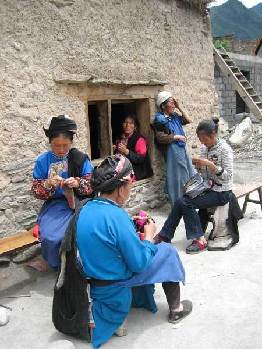 Qiang embroidery is a way for Qiang women to amuse themselves during a break from work. It keeps their hands busy while they chat. Photo: Zhai Qi |
Zhao Xingwu, a vice-director of the Sichuan Qiang Ethnic Study Center, said when the government tries to protect Qiang culture, it should avoid spending too much money on museum reconstruction, and shouldn't waste too much on experts' research. "That is problematic," he said.
Zhao said that building museums doesn't mean protection of the culture. Instead, the government should help more people like Yang to promote the authentic, local Qiang culture. "People represent the heart of a culture, not buildings and experts."
Zhao said the authorities had to build magnificent museums because "that is something the senior officials can see immediately and it shows they are doing their work. But if the money goes to the grass-root level, it takes more time to see results and the senior officials won't know right away."
Growing interest
Yang's troupe has held over 100 performances across the country in the past two years, and many of them are free.
"My troupe is not a money maker, it is a device to showcase Qiang culture," said the 47-year-old Yang. His troupe does make some profit, though not enough to make ends meet for 70 people.
Huang Jinghe, 20, one of the youngest performers in the troupe, was a tour guide in Chengdu before joining Yang's troupe.
"I am a Qiang ethnic, and that's why I'm in this troupe," Huang smiled. "Our culture has a few thousand years of history. It's our responsibility to carry on the tradi-tions of our ancestors and keep the culture alive."
Huang admitted that he makes half of what he earned (about 3,000 yuan) as a tour guide.
"I love to work here. The troupe members are like brothers and sisters," said Huang. "I don't know how long I can hold on. I have to save money to get married, and this is a problem for me to stay here. I have to make more."
The most valuable asset of Yang , the troupe director, is an old Volkswagen Jetta, which has already done more than 350,000 kilometers. The car's air conditioner was broken, and the windows were hard to open because the control buttons don't work properly.
Grief and anger
He lost his wife in the earthquake. His son survived the calamity but doesn't support what his father is doing; on the contrary, he believes it is a waste of time and energy to save the dying culture.
Yang tries to be tough. He doesn't complain except when he is high. In the light of the dying campfire, with many beer bottles emptied, he was in the mood.
"I wish the government takes us more seriously, but not as a business," he grumbled. He recalled that once a Taiwan organization invited the troupe for a show. But the local authorities decided to find some Han girls from the conservatory of music to represent Qiang culture, simply because they look "prettier".
"How can Han girls represent Qiang culture? It's ridiculous," Yang said, heaving a sigh.
Miles away from the base of Yang's troupe is Sanlong village, also in Mianyang. The houses in the village are Qiang-style stone residences that have been there for hundreds of years. Over the past two years, Wang Guoheng has been trying to save these old Qiang style residences from demolition. As the head of his clan, he claims that he felt the "pressure from his ancestors".