Tea Fight:an elegant showdown
Enjoying a longstanding peace in politics and economic prosperity, the Chinese Song Dynasty (960AD-1279AD) was a marvelous period during which many cultural traditions flourished. Tea-drinking, for example, became very popular at that time. Since the good government of that time called for more civil officials than brave generals, intellectuals were highly valued, and what the intellectuals treasured was an elegant way of living. Even when they were holding a competition, they pursued it in a genteel way. The ancient custom of the “Tea Fight” is a case in point.
| ?
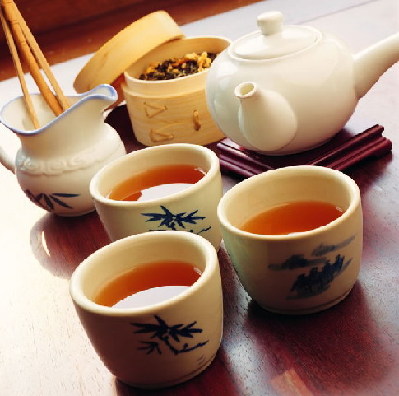 |
The “Tea Fight” custom, according to research, originated in Jian’an County, Fujian Province, where White Tea is harvested. In those days, when fresh tea had been picked and processed in late spring, each tea farmer would bring out his crop to fight for the honor of presenting his own tea to the emperor as a tribute. Later, the convention was borrowed and carried forward by the tea’s customers, including plain intellectuals, courtier officials, and even the emperors. When having a get-together, they were all fond of the competition to make good tea, and this tradition came to be called “tea fights”.
Litterateurs have written many works to record the theory and fun of the tea fight. According to their depiction, participants in the fight have to go through five processes before they present their tea for judgment: choosing the tea cake, grinding the tea, boiling the water, churning the cream, and infusing the tea while stirring.
To choose a fine tea cake is the sine qua non of making good tea. Usually, competitors will adopt a kind of semi-fermented cake made of white tea. The Emperor Huizong of Song put forward three criteria for a fine tea cake: in color, the cakes should look pure instead of mottled; in texture, they should be hard; and when broken, they should make a “crack” sound.
When a qualified cake has been chosen, it should be grinded. The tea maker wraps a small piece of the cake in a paper bag and grinds it with an edge runner. But this is not enough. Using a sieve, the maker also has to sieve out coarse particles. After this process, only a fine tea powder remains.
The third step is to boil the water. The ware that people of the Song Dynasty used for boiling was usually a narrow-necked kettle, which enabled them to judge the temperature of the water according to its sound. After the water is boiled, it is poured into a wide-mouthed clay jar for later use.
To make the cream is the fourth process of the preparation. Some tea powders need to be ladled out, and then mixed with a small quantity of water. The more viscous the cream is, the better the tea will be.
Then the most important job comes—the tea fighter has to infuse water into the teacup of cream and stir the solution at just the right speed. The water must come out smooth and steady, and the stirring has to be coordinated well with the pouring to produce a full dissolution.
Then what is the standard for good tea? That is to say, what makes a winner in a tea fight?
Firstly, good tea should look good in color. For White Tea, for example, the best color of the tea would be milky white. A milky green color indicates that the tea is undercooked, and milky grey or milky yellow would be even worse.
Secondly, judges will focus their attention on the foam that comes out after the tea is stirred. The foam of well-made tea will not disappear very soon, so the duration of the foam is an important standard with which to identify a good cup of tea. While the foam is still covering the liquid, the best state is to form a smooth and even quilt, just like the surface of a bowl of cold porridge.
To win the challenge, a good tea fighter will use special water and a rare tea cup, as well as a fine tea cake and his great skills. Black pottery cups are highly recommended in the competition, because the black and white contrast between the cup and the tea will be very pleasant to the eyes. A type of tea container called Tuhao Cups (cups with hare’s fur glaze) is said to be a valued ware in tea fighting, since the manufacturing process of them is rather complicated.
The Song Dynasty witnessed the heyday of the tea fights, but thereafter the custom waned. Japanese visitors, however, brought the art of the tea fight to their own country, and carried it forward into Sado, that is, the art of tea making. In fact, the spirit of the tea fight still exists in China. It comes out when people, in and out of the lands of tea-production, taste different teas and decide on a champion. Tea is an herb rich with cultural significance, embodying the philosophy of tranquility and elegance that the Chinese people have pursued throughout the history. Actually, the tea fight is not a fight; it is a romantic way of appreciating tea and life itself. Time flies and steam flows, but Chinese people’s musing on tea and attitude toward life will last forever.