Don't forget your Pleases and Thank-yous unless you're Chinese
Mama always taught me to remember my "pleases" and "thank-yous", but my Chinese friends have been trying to teach me to forget them.
You see, in the United States, you should always express your gratitude, no matter how close you are with others or how small their favors.
But in China, such keqi (politeness) is viewed as creating distance between peers who are more than acquaintances.
Whenever my parents cook a family dinner, I should thank them for the meal. And when my wife does me even a small favor, such as buying water on her way home or opening the door for me because my arms are heaving with groceries, I also should voice my gratefulness. And she does the same, too.
So, despite repeated chidings from my Chinese pals over the years, I just can't stamp out the habit.
A Chinese couple we regularly hang out with once asked us why we thanked each other so much. The woman then decided she likes the American way better and has started requiring her fianc to regularly declare his appreciation of everything she does for him. I doubt he will - or wants to - thank us for that one.
|
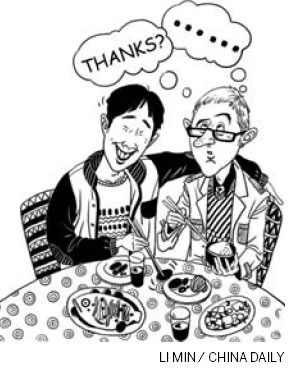 |
When I first started getting scolded by local buddies, I failed to recognize the importance of context. It began with Mr Hou, an elderly opera set designer, who reprimanding us when we thanked him for meals. Next, a younger friend rebuked me for thanking him with translation assistance. Another friend said she was "surprised" I'd speak with such courtesy.
So, for a while, I stopped saying "please" or "thank you" to all Chinese people. I was merely trying to avoid coming off as aloof.
But I was perplexed when I'd attend formal banquets, where toastmasters would profess the depth of their friendships with other participants in windy speeches ending with a rapid-fire string of at least three consecutive xiexie (thank-yous).
And when one acquaintance during this period suggested I say "thank you" more often, I was perfectly baffled.
Years ago, I came to understand the point of delineation is the actual degree of closeness. Americans, while generally gregarious, are usually slower to avow friendships as such until they're fairly deep.
But whatever is or isn't appropriate in China actually matters little, because I just can't help myself.
Sometimes I try holding my tongue after asking a favor or receiving help from a friend. But it just seems too much like I'm issuing an order rather than making a request. So I end up blurting out "thanks" anyway.
Now, while I know some Chinese friends might feel slightly put off by my American brand "formality", I feel the opposite about their lack of it.
I take it as a sign of friendship when people I know don't precede their requests with a "please" or receive my favors with a "thank you". But I hope they'll understand when I don't follow suit.
So, if I could, please, I'd like to take this chance to thank my Chinese friends for understanding. To them I say, "Xiexie, xiexie, xiexie!"