Banyan tree hugger
Saving banyan trees has become the life work of Su Debiao, who has given everything to protect his forest of banyan trees. Now, he stands on the brink of disaster. Liu Xiangrui reports
Parents today spare no effort in their quest to find Mr Right for their daughters, and Su Debiao, a 42-year-old native from Guangdong province's Zhongshan, is no exception.
But he has a far bigger headache than most parents, as he has more than 30,000 "daughters" to worry about. And what's worse, if he fails to find homes for them all in the near future, they might die.
"They are actually banyan trees I've adopted," says Su, the eldest son of a farming family, who has been collecting abandoned banyan trees, planting new ones, and providing them homes on rented land since 1993. "I love them exactly the way I love my daughters," he said.
|
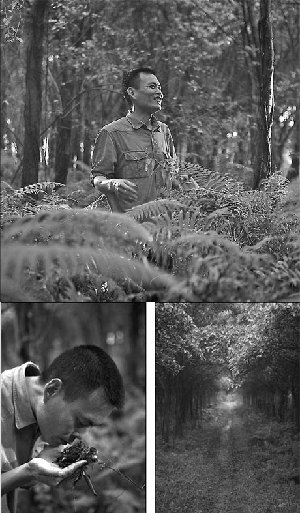 Top and above: Su Debiao from Zhongshan, Guangdong province, has taken care of more than 30,000 banyan trees on rented land for 17 years. PHOTOS BY FENG PINGSHEN / FOR CHINA DAILY |
Banyans, indigenous trees commonly found in South China, have lost much of their natural territory over the past three decades, as Guangdong province has developed into the country's major manufacturing base.
The displaced banyan trees are often casually replanted, which results in low survival rates, or simply abandoned because the common indigenous trees are seen as less attractive and valuable than more exotic species. Worst case scenario, they go directly to the paper mills.
Su, worked as a grocer, a worker in local factories, and even a ragman before he became a full-time eco-volunteer in 2005. His love of the banyans stems from his childhood, when he would sit in the shade of the huge trees. In 1986, he had his first encounter with a banyan forest, an experience that had a profound effect on him, and he returned to the forest many times, staying there for weeks at a time, until 1993 when the forest was cut down.
Shocked by the deforestation and worsening pollution, Su determined to do something.
Since then he has collected all the abandoned banyan he finds and replanted them on rented land, which now totals an area of nearly 400 mu or 27 hectares.
Except for his household expenses, Su has invested all his income caring for the banyans he has "adopted" over the years. The total rent for the land currently amounts to 400,000 yuan ($58,500) a year.
However, as his forest expands and land prices continue to escalate, the costs have become a growing burden on him. Especially since 2005, when he became a full time eco-worker, founding Nuture Land, a non-governmental organization dedicated to promoting contact with the nature and the preservation of indigenous food and customs.
Less income and higher rents forced him to mortgage his house to pay the land rent and moved in to his brother's with his family in 2006.
Now he is finding it hard to manage financially. He was advised by his friends to sell some trees to pay the rent, but he says, "I won't trade them for money because it's kind of like abandoning them," he says,
He will continue to raise the money to extend the contract for a 130 mu (8.6 hectare) piece of land, but says the rising costs and landowners who would rather lease their lands to more profitable business, such as fishery and industrial parks, mean that he must give up the rest. Indeed, the owners of land with leases that are about to expire have already begun digging up his trees and selling them at low prices as compensation for unpaid rent.
He has considered transforming his banyan forest into a non-profit eco-park, but he remains hesitant.
Instead, he would like to donate his trees to anyone who can provide a suitable home for them and is willing to take care of them. Su said it is better for him to give them away than for them to be destroyed.
"At least they might have a chance to survive rather than going directly to the paper mills," he says. "It's doesn't matter where they grow or whom they might belong to."
"Even when they stand far from me, I still can feel them, from deep inside, as we all breathe the same air and live in the same nature."
His slow, deliberate speech sometimes make him sound like a philosopher and some people have mistaken him for a Buddhist, thinking his upright sitting posture is the result of zazen.
"I am not (a Buddhist)," he says. "I just enjoy reflecting on the life I am living."
However, at the moment his reflections are full of sadness as he contemplates giving away his beloved banyans. "Sometimes I wish they were human, so that I could express my regrets to them for their sufferings," he says.