The absurd as real
By Yang Guang (China Daily)
Updated: 2010-03-12 09:44
 |
Large Medium Small |
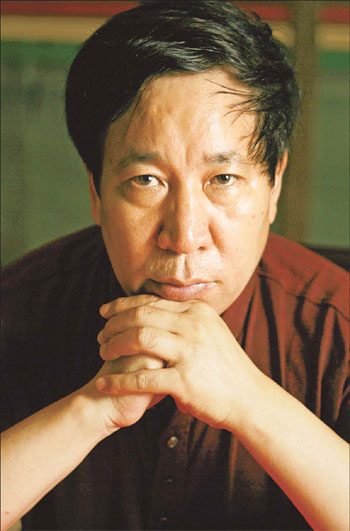
Writer Yan Lianke, who took up the pen for practical reasons, now finds inspiration in the philosophical. Yang Guang reports
The eye of a storm is peaceful, they say. So it is with writer Yan Lianke.
Yan, 52, remains unperturbed, despite being in the center of controversy ever since the publication of Hard as Water (Jianying Ru Shui) in 2001. None of his later works have failed to arouse debate - whether it is his subject matter or style of writing.
While literary critic Chen Xiaoming praises Yan's courage in challenging conventions, and sometimes taboos, with his piercing narration and fertile imagination, another critic Zhang Yiwu finds that Yan's feverish imagination is also his limitation.
"His problem is that he cannot contain his imagination, which results in a disconnect between the rural reality he observes, and his absurd literary representation of it," Zhang says.
"Controversy is a driving force for me, to some extent, because I've been experimenting with innovative literary elements, and they are sure to be accompanied by discussion and even debate," Yan says in a quiet caf near his house in northwest Beijing, in an easily distinguishable Henan accent.
Amid all this debate, nevertheless, Yan has bagged a dozen literary awards, including the top Lu Xun award in 1997 and 2001, and the Lao She award in 2004.
Despite penning numerous novels, novellas, short stories, essays and criticisms, Yan is honest enough to admit he started writing simply as a means to escape the poverty of his native Songxian county, Henan province.
Before enlisting in the People's Liberation Army in 1978, that "barren land" had already triggered in him a hunger - for food and pretty urban girls .
Yan sought to rise as a "cadre" so as to avoid being discharged at the end of four years. He resorted to writing, the one benefit he got out of reading ancient and Red classics by the sickbed of his older sister.
Fortunately for Yan, he was assigned as librarian during his second year in the army. He remembers how he used to lock himself up in the library, lie on a makeshift bed put together by two desks, and read voraciously in the warm winter sun or cool summer breeze, mostly 18th and 19th century Russian realistic novels.
In the meantime, his news reports and short stories began appearing in military newspapers.
Yan was informed he could stay in the army as a professional writer, just as the time to be discharged neared, after a drama performance based on his script won the first prize in a theater festival.
In the beginning, Yan wrote mostly about peasant soldiers, drawing inspiration from his own experiences. Then he turned to writing about rural life, modeled on his hometown but set in a fictional mountainous area called Palou.
He impressed literary circles, especially when studying at the People's Liberation Army Arts Institute for a degree in literature, during 1989 and 1991. He was known to be able to finish a short story within a day, and a novella within a week.
Yan says he realized the mistake of keeping to that pace after discovering that his 30 plus stories told only three or four stories, in essence.
When his health collapsed in 1995 because of serious lumbar and cervical spondylosis, it came as a blessing in disguise as it forced him to slow down.
"I used to be driven to write by worldly concerns such as fame and money, but after that collapse, I had to find other reasons to thrust me forward," Yan says.
And these he found in the resistance to fear - of power, of urban life, and of failing health. Ironically, power, urban life, and health, were all the things he once sought.
For now, the reason is to be free of the causal logic required in traditional fiction writing.
"Franz Kafka has long created the legacy, but we haven't inherited it," Yan says. Yan's most recent novel is about a child's absurd longing when confronted with death - the only request being that he be shot from the front, like a hero.
Despite having lived in Beijing for 16 years, Yan still doesn't feel he belongs to the city. At the same time, he is not able to return to the countryside, because the familiar ways of his village have all but disappeared.
Last year, he published My Father's Generation and I (Wo Yu Fubei), a memoir about his family and village, in an attempt to trace back his roots.
"To me the countryside is like the root of a tree, the source of a river, and the thread of a flying kite," says the professor at the School of Liberal Arts, Renmin University of China.
He will be in conversation with readers at the Bookworm International Festival on March 14.