LIFE> Travel

|
LIFE> Travel
|
|
Haunted heights
By
Raymond Zhou (China Daily)Updated: 2009-09-24 10:19
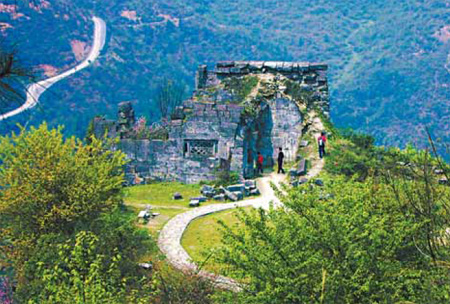
"I can hear weeping and howling at night - the voices of women and children coming from the bottom of the ravine," Liu Yuanguang says, pointing to a cliff from a protruded vista point. A few steps away is a small stone tablet inscribed with the words: "The Abyss for Execution." The lamenting voices emanate not only from deep down below but also from across four centuries. In June of the year 1600, more than 22,000 people, including women and children, were killed and tossed down this precipice. "There was so much blood that the river turned red, even in downtown Zunyi, 30 km away," Liu continues, as if he were a witness to the tragedy. The mass execution marked the end of a months-long siege. Occupying Hailongtun, a mountain with a flat peak built into a fortress, was Yang Yinglong and his army. The conquerors were Ming Dynasty (1368-1644) soldiers. Yang had declared independence in what is now northern Guizhou province. But Emperor Wanli was intent on wiping out all elements that did not pledge allegiance to the imperial court in Beijing. The Yang family had ruled Bozhou, now mostly Zunyi, for 700 years. The family was among hundreds of chieftain groups in this southwestern province. Theoretically, the chieftains were administrations of imperial China, but they were not appointed by the emperor. They instead gained power through warfare and bestowed it upon their descendants. Simply put, it was a form of "self-rule". During the Southern Song Dynasty (1127-1279), the Yang family successfully blocked an invading army of Mongols, "effectively rescuing Europe from the wrath of Genghis Khan's son, who had to withdraw from Poland, Hungary and even Vienna", explained Liu. Liu had been a tour guide for Hailongtun for 20 years and had enlisted in the army in his youth. But Fan Tongshou, a historian specializing in Guizhou, brushed aside this assertion as "making fun of history". He says the Mongols did not even enter Bozhou, and there was no military conflict in Hailongtun during the era. Records were sketchy, but it is clear that the fortress was first built in 1257. But not until the 16th century did the relationship between the Yang dominion and the royal court in Beijing take a nosedive. |
凤台县| 阳山县| 拉萨市| 东城区| 高雄市| 北碚区| 潜山县| 印江| 那曲县| 方城县| 新巴尔虎右旗| 水富县| 闽清县| 河东区| 东兰县| 霍林郭勒市| 寿阳县| 长宁县| 奉化市| 黄平县| 乌兰浩特市| 麦盖提县| 紫金县| 运城市| 高州市| 三都| 清新县| 呼图壁县| 蒙阴县| 瓮安县| 土默特左旗| 阿合奇县| 沾化县| 林周县| 康保县| 宁德市| 古蔺县| 日喀则市| 锡林郭勒盟| 田阳县| 青铜峡市|