LIFE> Travel

|
LIFE> Travel
|
|
Tibet's modern lamas
By Bai Xu and Hu Xing (China Daily)
Updated: 2009-03-13 10:34
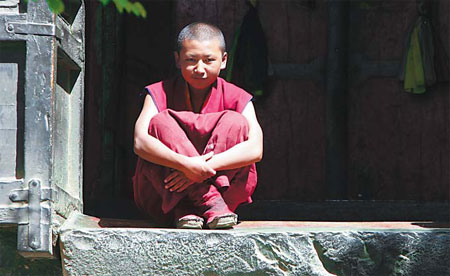
For Losang Zaxi, a 20-year-old lama in the Tashilhunpo Monastery of Xigaze in Tibet, life is not all that different from that of his peers. Every day, he spends his spare time watching TV and Jet Li's kung fu movies, listening to pop music and sending text message to his friends on his mobile phone. The quiet boy, a native of Xigaze, studied at a village primary school. He didn't want to study further, so he became a lama. "Being a lama was more difficult than school, because there were so many rules to follow in the monastery," he says. For instance, Internet cafes are strictly off-limits to monks of the Tashilhunpo Monastery. "There are too many temptations on the Internet. Once a monk is addicted, his study of Buddhism will suffer," says Losang Yignyen, 30, an assistant to Salung Phunlha, deputy chief of the monastery. According to Salung, the 600-year-old monastery now houses more than 800 lamas, with fewer than 300 young men like Losang. In the 1950s, there were nearly 5,000 lamas in the monastery. "They fell into three categories: pious believers, children of poor serfs who entered the monastery to make a living and those sent to the temples to meet a quota," he says. Temples had quotas for the serfs, and those who joined for this reason were called zunzhas. More than 70 percent of the lamas were from impoverished families, he says. Monasteries, along with aristocrats and government officials, were among the landowners in Tibet at that time. Farmers worked the land under contract and had to turn in grain, butter and fodder as tax. Hence, each lama at the temple could get 42 kg of food per month without doing any of the work it took to produce the food, says Qiangba, 64, a former lama in Tashilhunpo. After democratic reform in 1959, the manors and land were confiscated. Some 3,000 lamas left for a secular life. |
潢川县| 托克逊县| 柘城县| 石棉县| 南木林县| 佛坪县| 开江县| 咸宁市| 远安县| 上高县| 五大连池市| 宜章县| 通州市| 靖州| 南宁市| 肥东县| 和静县| 武鸣县| 凤台县| 左云县| 陆良县| 广昌县| 临潭县| 平顶山市| 四子王旗| 民勤县| 嘉兴市| 杂多县| 曲阜市| 新竹市| 江西省| 特克斯县| 南漳县| 南华县| 金华市| 石阡县| 友谊县| 湖南省| 子洲县| 准格尔旗| 从化市|